Maryam Aminu
Italy has reaffirmed its commitment to deepening economic, educational and diplomatic ties with Nigeria, expressing confidence that the resolution of the long-standing controversy involving ENI will unlock fresh investments and strengthen bilateral relations between both countries.
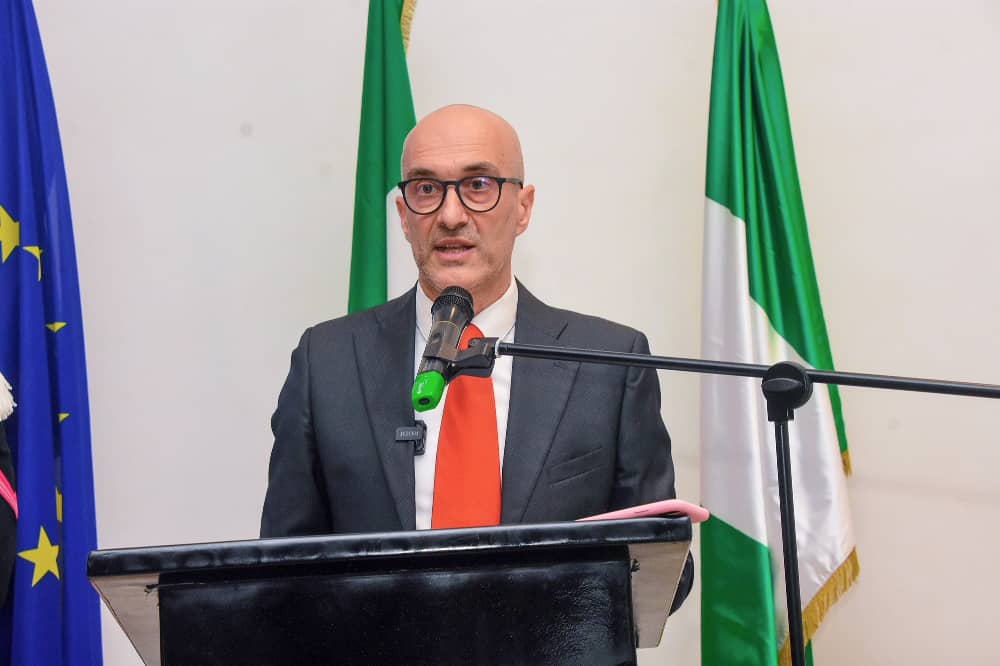
Speaking at a reception to mark the 80th anniversary of the Italian Republic in Abuja, the Ambassador of Italy to Nigeria, H.E. Roberto Mengoni, said Italy remained committed to supporting Nigeria’s democratic development, security and socio-economic progress while encouraging greater commercial engagement between the two nations.
Mengoni noted that Italian businesses have played significant roles in Nigeria’s development over the decades, citing companies such as AGIP, now known as ENI, Salini, B-Stabilini, Cappa D’Alberto and Orobica. He expressed optimism that more Italian companies and citizens would be encouraged to invest in Nigeria.
“We are sure that the resolution of the long pending controversy with ENI, thanks to the efforts of the Nigerian government, will bring more investments and interest from Italy,” he said.
The ambassador also highlighted growing cooperation between the two countries at the international level, recalling that President Bola Ahmed Tinubu attended an international conference on the fight against terrorism in Rome last year, where he met with Italy’s Prime Minister Giorgia Meloni.
According to him, Nigeria and Italy will later this year jointly chair the international conference for the replenishment of the Global Partnership for Education, a major global initiative aimed at supporting education, particularly across Africa.
Mengoni further acknowledged the contributions of Nigerians living in Italy, revealing that as of 2025, about 132,000 Nigerians were legally resident in the European country, working across transportation, industry, agriculture, hospitality and commerce while contributing to economic growth and social development.
He cited Paola Enogu, captain of the Italian women’s volleyball team that won gold at the Paris Olympics, as an example of the positive contributions of Nigerians and their descendants to Italian society, noting that she was born and raised in Italy to Nigerian parents.
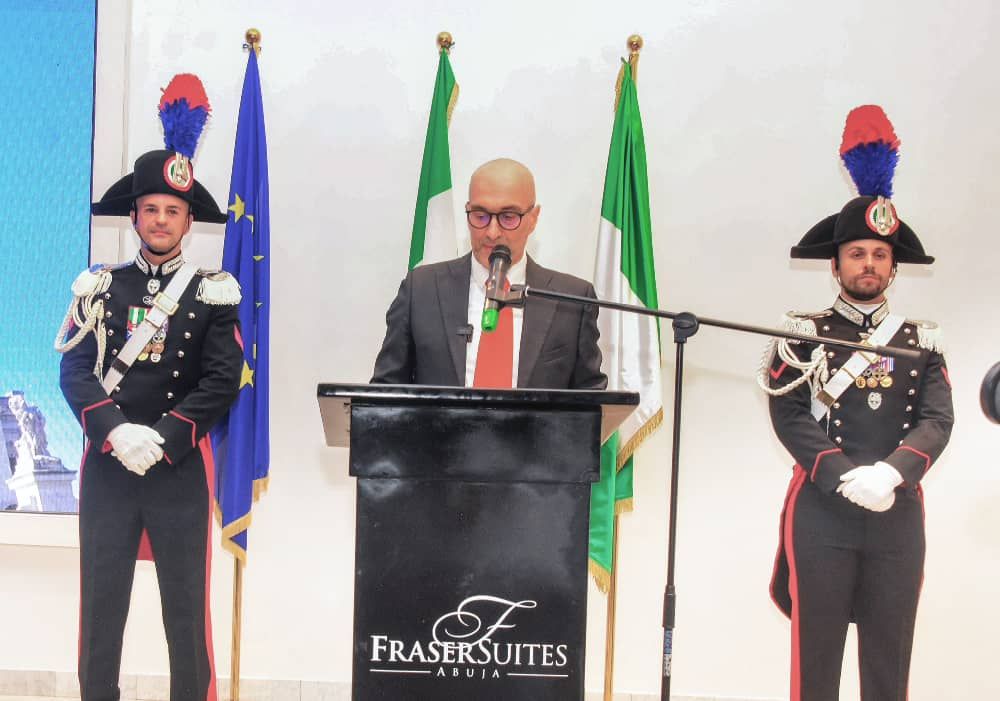
The envoy used the occasion of Italy’s Republic Day celebration to reflect on the country’s democratic journey since June 2, 1946, when Italians voted to establish a republic in the aftermath of World War II.
Describing the Italian Republic as “imperfect, troubled and beloved,” Mengoni said the country emerged from the devastation of war determined to reject fascism, colonialism, oppression and discrimination, while building a society founded on democracy, equality and inclusion.
He drew attention to Article 3 of the Italian Constitution, which guarantees equality before the law regardless of gender, race, language, religion, political opinion or social condition, and mandates the state to remove obstacles that limit citizens’ freedom and equality.
The ambassador also devoted a significant part of his address to the progress of women in Italy, recalling that women voted for the first time on June 2, 1946, and subsequently played key roles in drafting the country’s post-war constitution and rebuilding the nation.
He recounted how decades of activism by Italian women helped dismantle discriminatory laws and social barriers, allowing women greater freedom and participation in public life.
Quoting former minister Tina Anselmi, Mengoni said: “When women commit to change, their victories are victories for the whole society.”
Despite the progress made, he acknowledged that challenges remain, including gender inequality in political representation, employment opportunities, wage levels and violence against women.
On global affairs, the ambassador stressed the importance of international cooperation and adherence to international law in addressing conflicts and global challenges.
Referencing remarks by President Mattarella, he warned against the dangers of division and hostility, saying nations must choose between preserving international law and embracing confrontation that could lead to prolonged conflicts.
Looking ahead, Mengoni said Italy viewed Africa as a neighbour and partner in addressing shared challenges such as terrorism, international crime, poverty and climate change.
“Italy does not teach lessons,” he said. “We can only offer to Nigeria our imperfect example of a country that through decades of hard work has changed for the better.”
He added that the democratic journey that began in Italy 80 years ago remains a continuing process, driven by a commitment to peace, democracy, solidarity and social justice.


