AAAU Signs MoU with ATOM Aviation Training Services, Explores Strategic Partnership in Dubai

Emmanuel Daudu

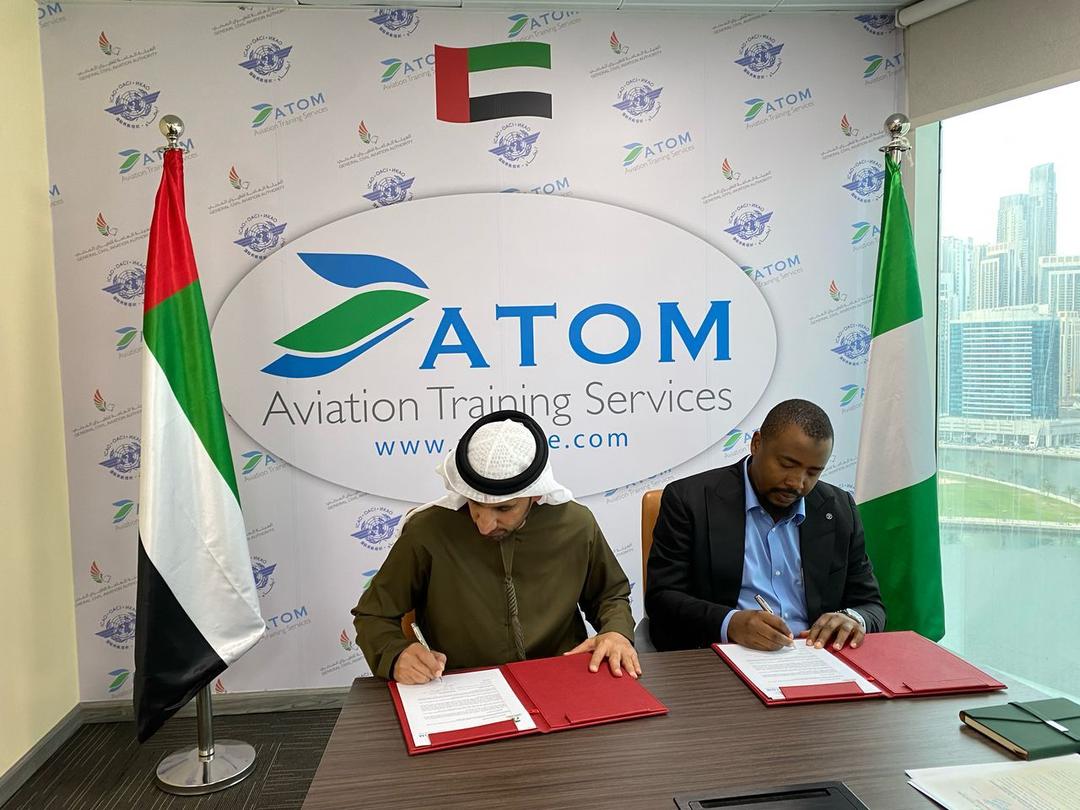
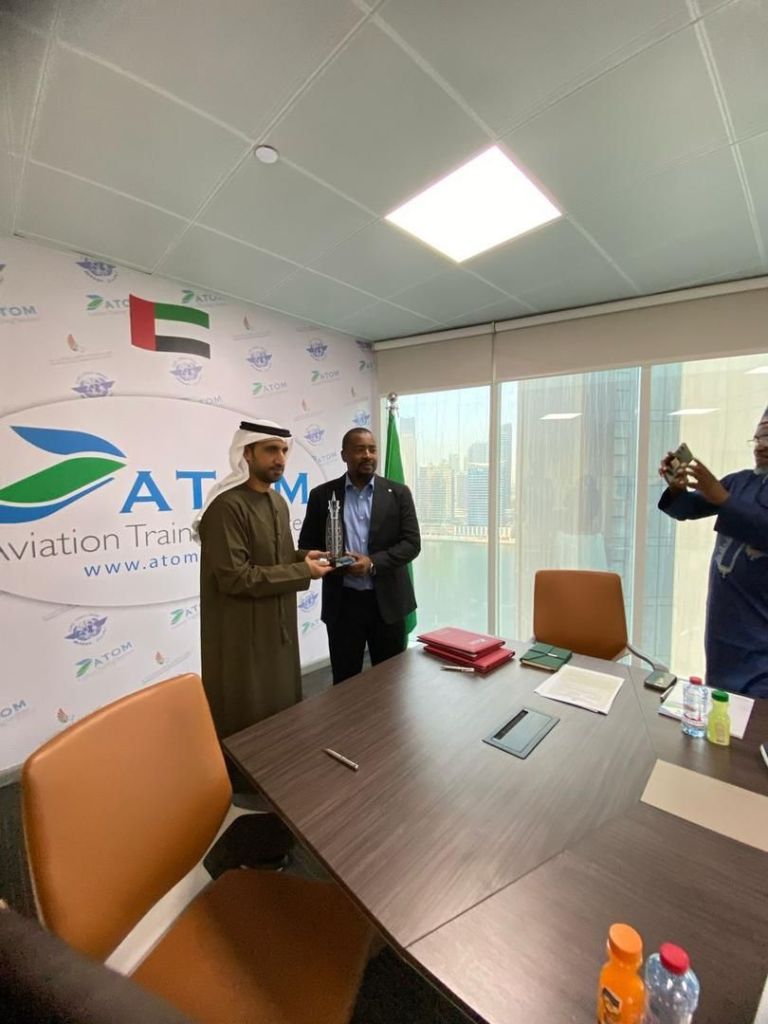
In a significant step toward advancing aviation education and professional training, the African Aviation and Aerospace University (AAAU), Abuja, has signed a Memorandum of Understanding (MoU) with ATOM Aviation Training Services, a leading aviation training institution based in Dubai, United Arab Emirates (UAE).

The MoU, signed on February 12, 2024, establishes a collaborative framework aimed at enhancing aviation training, resource sharing, and capacity building for industry professionals.

The signing ceremony brought together key officials from both institutions. The ATOM Aviation delegation, led by CEO Sheikh Mohammed Al-Memari, alongside Quality Manager Raed Al Batayneh and Training Manager Ibrahim Al Hazaimeh, warmly received the AAAU team, which was headed by Registrar Dr. Mustapha Sheikh Abdullahi, Director of Professional Training Programmes Mr. Aliyu Tata Azare, Public Relations Officer Ms. Sa’adatu Usman, and Mr. Anas Aliyu.

During the meeting, both teams engaged in in-depth discussions on knowledge exchange, skill development, and access to cutting-edge aviation technologies.

The partnership is expected to expand opportunities for AAAU students and professionals to gain specialized training and global industry exposure.

Following the MoU signing, the AAAU delegation toured ATOM’s state-of-the-art training facilities, gaining firsthand insights into the institution’s advanced simulators, modern training infrastructure, and industry-focused curriculum.

This visit reinforced the potential for collaboration in curriculum development, research initiatives, and professional certifications.

This partnership aligns with AAAU’s vision to position itself as a leading center for aviation and aerospace education in Africa, equipping the next generation of aviation professionals with world-class skills and expertise.

It also supports Nigeria’s broader goal of strengthening its aviation sector through international partnerships and technological advancements.

With this agreement, AAAU and ATOM Aviation Training Services are set to transform aviation education, create new learning opportunities, and contribute to the sustainable growth of the global aviation industry.

2025: A Year of Consolidation – FG Showcases Tinubu Administration’s Achievements

Emmanuel Daudu

The Federal Government has declared 2025 as a year of consolidation, as President Bola Ahmed Tinubu’s administration builds on the significant progress made since assuming office.

The Honourable Minister of Information and National Orientation, Muhammed Idris, made this announcement at a Ministerial Press Briefing in Abuja, highlighting key achievements over the past 19 months.

“This inaugural briefing for 2025 serves as a moment of reflection on how far we have come and the transformative strides we continue to make under President Tinubu’s leadership,” Idris stated.

The Minister outlined notable milestones across governance, economy, security, and infrastructure.

Economic and Fiscal Reforms

Fuel Subsidy Removal: Ending the subsidy has saved Nigeria hundreds of billions of Naira annually, redirecting funds to critical sectors.

Foreign Exchange Stability: The Electronic Foreign Exchange Matching System (EFEMS) has stabilized the forex market, cleared billions in backlog payments, and improved investor confidence. The Naira recently hit an eight-month high in the official market.

Oil and Gas Investment Boom: Nigeria attracted over $5 billion in Final Investment Decisions (FIDs) in 2024, making it Africa’s top investment destination in the sector.

Electricity Sector Reforms: The 2024 Electricity Act enables state governments to develop and regulate their electricity markets, expanding power access.

Local Government Autonomy: A Supreme Court ruling in July 2024 granted local governments financial independence, with an Inter-Ministerial Committee ensuring implementation.

Targeted Social and Economic Interventions

Students Loan Fund (NELFUND): Over 169,000 students have received N32.8 billion in tuition and upkeep support.

Regional Development: New Development Commissions have been established for the North-Central, South-East, and North-West regions, alongside the creation of a Federal University of Environmental Technology.

Healthcare Investments: The Federal Executive Council approved $1.07 billion from the World Bank for health programs, including targeted subsidies for cancer patients.

Passport Processing Reforms: Over 200,000 international passport backlogs were cleared within three weeks in 2024.

Compressed Natural Gas (CNG) Expansion: The government has invested over $450 million in developing Nigeria’s CNG value chain to reduce dependence on petrol.

Infrastructure Development

Under President Tinubu’s leadership, Nigeria has become a hub of construction activity, with major projects receiving significant funding:

Lagos-Calabar Coastal Highway – N1.334 trillion

Access roads to the Second Niger Bridge – N470.9 billion

Lagos-Ibadan Expressway reconstruction – N195 billion

Security and Defence Enhancements

Over 8,000 terrorists and bandits neutralized and 8,000 kidnapped victims rescued in 2024.

A Multi-Agency Anti-Kidnap Fusion Cell was established in partnership with the UK’s National Crime Agency to combat abductions.

Food Security and Agriculture

The newly established Ministry of Livestock Development is driving agricultural reforms, leading to lower grain prices and unlocking multi-billion-dollar opportunities in livestock farming.

2025 Budget: A Focus on Growth and Stability

President Tinubu’s N54.2 trillion “Budget of Restoration” prioritizes:

Security – N4.91 trillion

Infrastructure – N4.06 trillion

Education – N3.52 trillion

Health – N2.48 trillion

Minister  reiterated that these reforms are strengthening Nigeria’s economy, improving fiscal capacity, and enhancing citizens’ quality of life.

“We are witnessing a transformation one that renews hope for all Nigerians, regardless of age or background,” he concluded.

FG Inaugurates Inter-Sectoral Technical Working Committee on Young Adolescent Health

Maryam Aminu

The Federal Government has inaugurated the Young Adolescent Technical Working Committee, a specialized body aimed at addressing the developmental and health needs of young people across the country.

Speaking at the inauguration ceremony in Abuja, the Honourable Minister of Youth Development, Comrade Ayodele Olawande, reaffirmed President Bola Ahmed Tinubu’s commitment to youth health under the Renewed Hope Agenda.

He emphasized that the well-being of young people is crucial for them to fully benefit from various empowerment and development programs initiated by the administration.

“Health is not merely the absence of disease but a complete state of mental, physical, and social well-being. I am pleased that this committee will focus on critical issues such as mental health, substance abuse, HIV, HPV, and non-communicable diseases,” Olawande stated.

He urged committee members to implement their plans promptly, ensuring swift action on key initiatives.

In his remarks, the Permanent Secretary of the Ministry, Olubunmi Olusanya, represented by the Director of General Services, Mr. Wale Joseph, encouraged the committee to intensify efforts in executing its mandate.

He highlighted the importance of a healthy youth population, describing the initiative as timely and essential for the nation’s future.

The committee is expected to drive policies and programs that will enhance health services for young adolescents, ensuring that their voices and well-being remain a priority in national development efforts.

RMAFC Chairman Engages Commissioners, Management, and Staff to Strengthen Teamwork and Operational Efficiency

Maryam Aminu

In a bid to enhance collaboration and ensure seamless operations, the Chairman of the Revenue Mobilization Allocation and Fiscal Commission (RMAFC), Dr. Mohammed Bello Shehu, has held an interactive session with Commissioners, management, and staff at the Commission’s headquarters in Abuja.

The engagement provided an opportunity for the staff to meet the newly appointed Commissioners and reinforce the Commission’s commitment to teamwork and efficiency. Addressing the gathering, Dr. Shehu emphasized the importance of cooperation, urging staff to extend the same level of support and dedication they had shown to their predecessors.

“The purpose of this gathering is to introduce you to the new Commissioners and to encourage a spirit of collaboration. I urge every staff member to work closely with them both returning and newly appointed to ensure the smooth continuation of the Commission’s work,” he stated.

Acknowledging the resilience and dedication of the Commission’s workforce, Dr. Shehu commended their unwavering commitment despite challenges over the years.

He reaffirmed his belief in teamwork as a driving force for success, urging everyone to contribute meaningfully toward achieving the Commission’s mandate and supporting President Bola Ahmed Tinubu’s renewed hope agenda.

“Your dedication, perseverance, and goodwill have been instrumental in keeping the Commission moving forward. I encourage you to remain steadfast in your duties so we can continue delivering on our objectives,” he added.

The Chairman also motivated staff to aspire for greater career growth within the Commission, reinforcing the potential for advancement through hard work and dedication.

“Every staff member has the potential to rise through the ranks whether as a Commissioner, Secretary, or even as Chairman. Hard work is recognized and rewarded, and I urge you to remain committed to excellence,” he affirmed.

A cross section of federal commissioners and staff of the Commission at the occasion

Speaking on behalf of the Commission’s Secretary, Engr. Joseph Okechukwu Nwaeze, the Director of the Inland Revenue Department, Mrs. Udodirim Okwongu, praised the Chairman and Commissioners for their exemplary leadership.

She noted that their guidance had continued to inspire staff to give their best in service to the nation.

Federal Commissioners at the event also underscored the importance of teamwork, emphasizing that collective effort is vital for the Commission to fulfill its mandate.

In the same vein, directors of various departments pledged their unwavering support to the leadership while reaffirming their dedication to the Commission’s objectives.

The interactive session ended on a high note, with staff members expressing their appreciation for Dr. Shehu’s leadership style and reiterating their commitment to advancing the Commission’s mission.

NSC Chairman Hails Waldorf Knoll’s Inter-House Sports, Pledges Support for Grassroots Development

Waldorf Knoll’s recent inter-house sports event has received high praise from the National Sports Commission (NSC) for aligning with President Bola Ahmed Tinubu’s grassroots sports development program. According to NSC Chairman, Mallam Shehu Dikko, the school’s event demonstrates a clear commitment to identifying and nurturing young talents across Nigeria

Dikko who doubled as the Chairman of the event hailed the way Waldorf Knoll organized the inter-house sports adding that it will make it easy for the Commission to identify talents scattered around Nigeria. He therefore promised the Commission supports to make it better than what it is

“So the Inter-house sports happening here today clearly speaks and aligns with our objective. I have been coming here even before I became the Chairman of National Sports Commission, so, it is something that is deep and is in my heart I am not just here for the fun of it. So, I will use that position to advance it to make it much more better and to create more advocacy that we need that will align with this vision of President Bola Ahmed Tinubu.

“In fact, what we did was to set up Committee between National Sports Commission and the Federal Ministry of Education to see how we can work together and identity talents.

“In the meeting we had we the Vice Chancellors, Directors, Provost is to put them on alert that we now have to fucus on the sport and already we have seen the outcome for example we have got letters from University of Jos who have presented themself to us as the Center of Excellence for North Central. They are now focusing on setting up national courses of sports. There will be Degree Courses of sport activities to align with other international schools, so that they can be friendly to them.

FG Unveils Renewed Hope Youth Strategic Blueprint to Donors, Unlocks Nigeria’s Youth Potential for Economic Growth

Maryam Aminu

The Federal Government has officially unveiled the Renewed Hope Youth Strategic Blueprint to donor agencies, signaling a major step toward harnessing Nigeria’s vast youth potential to drive economic transformation.

Speaking at the donor engagement meeting, the Honourable Minister of Youth Development, Comrade Ayodele Olawande, emphasized the critical role of young Nigerians in shaping the nation’s future.

“With over 70% of our population more than 130 million falling within the youth age bracket, Nigeria has a unique advantage for socio-economic transformation,” he said.

The Minister acknowledged that while this demographic strength presents opportunities, it also comes with challenges.

He stressed that strategic investments, innovation, and partnerships with donors would be key to overcoming obstacles and creating a thriving environment for young people.

Addressing the issue of youth unemployment, Olawande highlighted the impressive strides made by the current administration.

“The youth unemployment rate has dramatically decreased from 12.55% in 2020 to 5.84% in 2023, demonstrating the effectiveness of targeted policies and initiatives. However, despite this progress, it slightly increased to 6.5% in the second quarter of 2024. This underscores the need for sustained collaboration and investment in youth-focused programs,” he noted.

He called on donor agencies to recognize both the achievements and the need for continued efforts, emphasizing that innovative programs and skills development initiatives are critical in ensuring young people thrive in today’s competitive job market.

The Minister further underscored the importance of strengthening government institutions, including the Federal and State Ministries of Youth, the NYSC, and the Citizenship and Leadership Training Centre (CLTC), through organizational reforms and capacity-building. He stressed that these institutions must evolve to meet the demands of the 21st century and serve as platforms for impactful youth development policies.

He also urged donors to support initiatives that reshape youth behavior and mindsets, particularly in an era dominated by social media and digital technology. With Nigeria’s population projected to hit 350 million by 2050, Olawande warned that the youth could either become a valuable global human resource or a burden to society if not properly equipped.

The Honourable Minister, Federal Ministry of Youth Development, Comrade Ayodele Olawande (3rd Right), The Chairman of the Senate Committee on Youth Development, Hon. Yemi Adaramodu (Middle), and the Permanent Secretary, Olubunmi Olusanya (1st Left) at the Donor Engagement meeting with different agencies.

Key donor agencies at the meeting reaffirmed their commitment to supporting youth development initiatives in Nigeria.

Dr. Osubor Gregory, a representative of the African Development Bank (AfDB), highlighted the organization’s unwavering dedication to empowering young people through innovative programs.

The African Development Bank is determined to ensure that every project directly benefits youth, fostering their growth and potential for a brighter future,” he stated.

Similarly, Ibrahim Suraju, representing the Islamic Bank, commended the Ministry’s commitment to youth empowerment and sustainable development.

“The Islamic Bank is dedicated to supporting initiatives that enhance skill development, promote capacity-building, nurture entrepreneurship, and drive innovation. These elements are not just important they are essential catalysts for sustainable economic growth,” Suraju said.

The engagement marked a significant milestone in forging partnerships between the government and donor agencies to advance youth-focused policies and unlock Nigeria’s economic potential.

Onoh Blasts Buhari: Your 8 Years Were the Las Vegas of Corruption and Insecurity

Maryam Aminu

Former Southeast campaign spokesman for President Bola Tinubu, Dr. Josef Onoh, has strongly criticized former President Muhammadu Buhari’s claims of improving Nigeria’s security and economy during his eight-year tenure.

Buhari made the assertion while hosting members of the Katsina State Correspondents’ Chapel of the Nigerian Union of Journalists (NUJ) at his Daura residence. He insisted that Nigeria fared better under his administration compared to 2015.

However, in a swift rebuttal, Onoh described Buhari’s tenure as a period of severe economic mismanagement and unprecedented insecurity, stating that Tinubu’s government is currently bearing the brunt of his failures.

“Tinubu Chose to Carry the Burden Silently”

Onoh argued that Nigerians unfairly blame Tinubu for the country’s economic hardship, unaware that Buhari’s administration left behind a system riddled with crises.

“Nigerians today accuse Tinubu’s administration of being the worst without realizing that the President has chosen to carry his cross silently rather than shift blame,” he said.

He emphasized that Buhari’s government failed to stop Tinubu from becoming president, but now, his administration is forced to navigate the economic minefields left behind.

Onoh painted a grim picture of Nigeria’s security under Buhari, citing statistics that contradicted the former president’s claims. According to him, when Buhari took office in 2015, Nigeria had recorded 34,972 deaths from violence, but by May 2023, the death toll had surged to 98,083.

“Under your watch, Nigeria recorded more insecurity than at any other time in history including the Civil War. States in the northeast, north-central, southeast, and southwest couldn’t sleep in peace,” he stated.

Onoh highlighted figures of violent deaths from 2015 to 2023:

2015: 5,556

2016: 5,763

2017: 4,618

2018: 6,565

2019: 8,340

2020: 9,694

2021: 10,575

2022: 9,079

2023: 2,921

He further detailed a timeline of killings in just May 2023, citing multiple attacks, banditry, kidnappings, and insurgency-related deaths across the country.

Of HH will you eat the noh pointed out that under Buhari’s administration:

Nigeria was ranked third most terrorized country after Afghanistan and Iraq in the Global Terrorism Index (2019).

The country was the 14th most fragile nation in the world and 9th in Africa in the Fragile States Index.

In the Global Peace Index, Nigeria ranked 148th out of 163 nations, trailing behind war-torn countries like Sierra Leone, Liberia, and Rwanda.

“Your failure to handle insecurity gave room for Boko Haram and bandits to thrive, crippling businesses and investments. The Tinubu administration has had to clean up the mess you left behind,” he stated.

“Buhari’s Legacy? A Recharge Card Seller Turned Billionaire”

Onoh also took a jab at the corruption scandals that plagued Buhari’s tenure, pointing to the overnight wealth of politically connected individuals.

“One of Buhari’s greatest economic contributions was the overnight transformation of a recharge card seller into a billionaire, while a serving CBN governor ran for president using public funds,” he remarked.

He credited National Security Adviser Mallam Nuhu Ribadu for achieving in 18 months what Buhari’s security chiefs failed to do in eight years. He also commended Enugu State Governor Peter Mbah for tackling the IPOB sit-at-home menace with the support of the Tinubu-led government.

“Your 8 Years Were a Casino of Corruption and Chaos”

Onoh ended his critique with a sarcastic remark:

“Yesterday, Buhari’s administration introduced ‘Ranka ya dede’ nepotism, today it’s ‘Emilokan,’ tomorrow it might be ‘Igbo Kwenu.’ But one thing is clear: your eight years in office were truly the Las Vegas of insecurity and corruption.”

Maryam Aminu

Former Southeast campaign spokesman for President Bola Tinubu, Dr. Josef Onoh, has strongly criticized former President Muhammadu Buhari’s claims of improving Nigeria’s security and economy during his eight-year tenure.

Buhari made the assertion while hosting members of the Katsina State Correspondents’ Chapel of the Nigerian Union of Journalists (NUJ) at his Daura residence. He insisted that Nigeria fared better under his administration compared to 2015.

However, in a swift rebuttal, Onoh described Buhari’s tenure as a period of severe economic mismanagement and unprecedented insecurity, stating that Tinubu’s government is currently bearing the brunt of his failures.

“Tinubu Chose to Carry the Burden Silently”

Onoh argued that Nigerians unfairly blame Tinubu for the country’s economic hardship, unaware that Buhari’s administration left behind a system riddled with crises.

“Nigerians today accuse Tinubu’s administration of being the worst without realizing that the President has chosen to carry his cross silently rather than shift blame,” he said.

He emphasized that Buhari’s government failed to stop Tinubu from becoming president, but now, his administration is forced to navigate the economic minefields left behind.

Security Collapse Under Buhari

Onoh painted a grim picture of Nigeria’s security under Buhari, citing statistics that contradicted the former president’s claims. According to him, when Buhari took office in 2015, Nigeria had recorded 34,972 deaths from violence, but by May 2023, the death toll had surged to 98,083.

“Under your watch, Nigeria recorded more insecurity than at any other time in history—including the Civil War. States in the northeast, north-central, southeast, and southwest couldn’t sleep in peace,” he stated.

Onoh highlighted figures of violent deaths from 2015 to 2023:

2015: 5,556

2016: 5,763

2017: 4,618

2018: 6,565

2019: 8,340

2020: 9,694

2021: 10,575

2022: 9,079

2023: 2,921

He further detailed a timeline of killings in just May 2023, citing multiple attacks, banditry, kidnappings, and insurgency-related deaths across the country.

Nigeria’s Global Rankings Under Buhari

Onoh pointed out that under Buhari’s administration:

Nigeria was ranked third most terrorized country after Afghanistan and Iraq in the Global Terrorism Index (2019).

The country was the 14th most fragile nation in the world and 9th in Africa in the Fragile States Index.

In the Global Peace Index, Nigeria ranked 148th out of 163 nations, trailing behind war-torn countries like Sierra Leone, Liberia, and Rwanda.

Former President Muhammadu Buhari

“Your failure to handle insecurity gave room for Boko Haram and bandits to thrive, crippling businesses and investments. The Tinubu administration has had to clean up the mess you left behind,” he stated.

“Buhari’s Legacy? A Recharge Card Seller Turned Billionaire”

Onoh also took a jab at the corruption scandals that plagued Buhari’s tenure, pointing to the overnight wealth of politically connected individuals.

“One of Buhari’s greatest economic contributions was the overnight transformation of a recharge card seller into a billionaire, while a serving CBN governor ran for president using public funds,” he remarked.

He credited National Security Adviser Mallam Nuhu Ribadu for achieving in 18 months what Buhari’s security chiefs failed to do in eight years.

He also commended Enugu State Governor Peter Mbah for tackling the IPOB sit-at-home menace with the support of the Tinubu-led government.

“Your 8 Years Were a Casino of Corruption and Chaos”

Onoh ended his critique with a sarcastic remark:

“Yesterday, Buhari’s administration introduced ‘Ranka ya dede’ nepotism, today it’s ‘Emilokan,’ tomorrow it might be ‘Igbo Kwenu.’ But one thing is clear: your eight years in office were truly the Las Vegas of insecurity and corruption.”

Governments, National Assembly Urged to Adopt Local Solutions for Security in Northeast, Northwest

Maryam Aminu

The National and State Assemblies, alongside the federal and state governments, have been called upon to adopt localized solutions to address the ongoing security crisis in Nigeria’s Northeast and Northwest regions.

Security experts emphasize that since security is fundamentally local, prioritizing the safety and protection of citizens in these regions is crucial.

Peter Maduoma, Acting Executive Director of the CLEEN Foundation, highlighted the urgent need for a multi-faceted approach to counter terrorism.

He stressed that tackling the root causes of insecurity such as poverty, unemployment, and lack of education would prevent terrorist groups from recruiting new members and gaining public sympathy.

He also urged the National Assembly and the top military leadership to review existing rules of engagement and operational protocols for security and law enforcement agencies.

This, he said, would align their operations with best practices that ensure civilian protection and uphold human rights.

Furthermore, Maduoma emphasized the importance of strengthening civil-military relations and community engagement.

According to him, building trust between security forces and local communities would enhance intelligence gathering and encourage community support for counterterrorism efforts.

“In the fight against terrorism, a whole-of-society approach is essential. From federal to state and local governments, from security agencies to non-state actors including civil society, the media, and development partners everyone has a role to play,” Maduoma stated.

He called for innovation and collective action to combat terrorism, ensuring a safer and more secure Nigeria through coordinated efforts at all levels of governance and society.

FRC Launches 2025 Knowledge-Sharing Series on Budgetary Reforms

Maryam Aminu

The Fiscal Responsibility Commission (FRC) has launched its 2025 Knowledge-Sharing Series, aimed at advancing budgetary reforms to strengthen governance and promote fiscal responsibility in Nigeria.

Delivering the keynote address, Dr. Emeka Ejikonye, a public budgeting expert and Principal Consultant/CEO of ReGo Consulting, emphasized the need for government officials to move beyond “tunnel vision governance” and actively engage with citizens.

He stressed that the ultimate goal of governance is to enhance the quality of life for Nigerians.

In his remarks, FRC Executive Chairman, Victor Muruako, commended the fiscal reforms introduced by President Bola Ahmed Tinubu, expressing optimism that they will soon translate into tangible economic benefits for Nigerians.

He highlighted the removal of oil subsidies and the implementation of tax reforms as critical steps toward economic stability. However, he cautioned that the effectiveness of these reforms depends on their proper execution by government agencies.

Reaffirming its commitment to transparency, accountability, and sound financial management, the FRC pledged to continue driving reforms that will ensure sustainable development and long-term economic growth in Nigeria.

Women Affairs Minister Marks 100 Days in Office, Outlines Bold Reforms for Women and Children

By Adejoh Bilkisu

The Honourable Minister of Women Affairs, Hon. Imaan Sulaiman-Ibrahim, has marked her first 100 days in office with the unveiling of a series of transformative initiatives aimed at empowering women, strengthening child protection laws, and ensuring the inclusion of vulnerable groups in Nigeria’s development agenda.

Speaking at a press briefing in Abuja, the Minister stressed the need for a results-driven approach to addressing gender inequality, economic exclusion, and child welfare concerns.

She emphasized that the Ministry was committed to shifting from policy development to measurable impact, ensuring that Nigerian women and children were not left behind.

The Minister disclosed that the Ministry had set a target to economically empower 10 million women by 2027 in alignment with President Bola Ahmed Tinubu’s vision of a $1 trillion economy. She explained that to achieve this, several initiatives had been launched, including the Nigeria for Women Scale-Up Project, a World Bank-supported program aimed at equipping 4.5 million women across all 36 states and the FCT with financial literacy and business development skills.

She further revealed that the MOWA-SARA Accelerated Skills Acquisition Programme, in partnership with WEMA Bank, had been introduced to train 500,000 women in vocational skills, entrepreneurship, and financial inclusion. She noted that the first phase of the program was already underway in Kano State, where 2,500 women were currently receiving training.

The Minister also stated that plans were in place to establish a National Microfinance Framework for Women Entrepreneurs, which would provide affordable credit and investment opportunities for women-led businesses.

Cross session of the distribution

Acknowledging the economic hardship faced by many families, she announced that the Ministry had launched a Food Intervention Program to support women and vulnerable groups, ensuring that no woman or child was left behind.

Addressing child welfare concerns, the Minister revealed that efforts were being made to strengthen Nigeria’s child protection framework.

She announced that a Child Rights Act Review Committee had been set up to harmonize and modernize child protection laws, with a focus on implementing stricter penalties for child abuse, trafficking, and early marriage.

She added that nationwide consultations were being conducted to develop a National Child Protection Framework, which would provide a coordinated approach to safeguarding children.

She also disclosed that plans were underway for the establishment of a dedicated institution for Child Protection and Development, which would focus on implementing child welfare policies, strengthening protection services, and providing holistic support for vulnerable children.

As part of efforts to promote menstrual hygiene among young girls, the Minister revealed that the Ministry had launched a nationwide campaign targeting 10,000 girls with free hygiene kits to help them stay in school and maintain their dignity.

Speaking on Nigeria’s commitment to ending gender-based violence, she highlighted the country’s pledge at the Global Ministerial Conference on Ending Violence Against Children in Bogotá, Colombia, where it committed to providing comprehensive support services to two million children at risk of violence, abuse, and exploitation by 2030.

She added that Nigeria also aimed to deliver evidence-based parenting programs to 10 million families within the same period.

Sulaiman-Ibrahim further disclosed that Nigeria would take a leading role at the Commission on the Status of Women (CSW69) in New York, where the country would host six high-impact sessions on women’s leadership and empowerment, financial inclusion for women, and child protection rights.

She noted that this marked a shift from passive participation to active leadership in global gender advocacy.

Additionally, the Minister revealed that Nigeria was set to participate in COP29 in Azerbaijan, where it would advocate for gender-responsive climate action and work towards transitioning one million households to clean energy solutions.

The Minister underscored the importance of collaboration in achieving gender and social development goals, stating that the Ministry had strengthened engagement with state governments, particularly the Women Affairs Commissioners across the 36 states, to ensure better synergy and policy alignment. She also mentioned the formation of the High-Level Presidential Advisory Council on Women and Girls (HLAC), which would drive and coordinate gender-focused programs at the national level.

She highlighted that in the past 100 days, the Ministry had deepened partnerships with development organizations, civil society, and the private sector, fostering a multi-stakeholder approach to advancing gender equality, child protection, and social inclusion.

Hon. Sulaiman-Ibrahim called for stronger partnerships, faster implementation, and a unified approach to addressing gender and social development challenges.

She emphasized that the time for incremental progress was over and that bold action was required.

To commemorate the 100-day milestone, the Ministry distributed essential items, including wrappers, bags of rice, solar-powered devices, and other relief materials, to women and vulnerable groups.

The Minister noted that these donations were aimed at alleviating the economic burdens faced by many families and reinforcing the government’s commitment to improving the welfare of Nigerian women and children.

Reaffirming the administration’s commitment to gender equality, women’s empowerment, and child protection, the Minister described these initiatives as fundamental pillars of Nigeria’s economic and social development.

She called on government agencies, private sector partners, civil society organizations, and the international community to support efforts in accelerating gender-responsive policies, strengthening child protection mechanisms, and ensuring that no Nigerian woman or child was left behind.

With these reforms, she asserted that Nigeria was set to take a leadership role in global gender advocacy, ensuring that women and children remained at the center of national development efforts.

As the Ministry embarked on the next phase of its agenda, the Minister assured Nigerians that the government remained fully committed to delivering tangible results that would improve the lives of women, children, and vulnerable groups across the country.