
Maryam Aminu
The Fiscal Responsibility Commission (FRC) and the House of Representatives Committee on Petroleum Resources (Upstream) have jointly unveiled a new Policy Paper aimed at strengthening good governance, fiscal discipline, and accountability in Nigeria’s petroleum sector.
In a statement signed and made available to journalists on Monday in Abuja, Bede Ogueri Anyanwu, Head of the Strategic Communications Directorate of the FRC, said the document was presented at a high-level Legislative Stakeholders’ Workshop convened to address transparency gaps and deepen oversight in the country’s most critical revenue-generating industry.
FRC Executive Chairman, Victor Muruako, described the policy paper as a “timely and significant milestone” in national efforts to entrench accountability across the oil and gas value chain. He commended the strong participation of lawmakers, regulators, and sector experts, noting that the initiative aligns with the Commission’s mandate under the Fiscal Responsibility Act (2007).
Muruako also applauded the Chairman of the House Committee on Petroleum Resources (Upstream), Rt. Hon. Alhassan Ado Doguwa, OON, whose remarks were delivered by Hon. Kalifat Ogbara, Chairperson of the House Committee on Women Affairs. He said Doguwa’s consistent commitment to legislative reforms has strengthened sector governance and enhanced fiscal oversight.
A key highlight of the workshop was the formal presentation of the Policy Brief an outcome of extensive research into the 10th National Assembly’s legislative interventions in the upstream petroleum sector. The document reviews existing laws, institutional structures, and oversight mechanisms, and identifies governance gaps that continue to impede fiscal transparency.
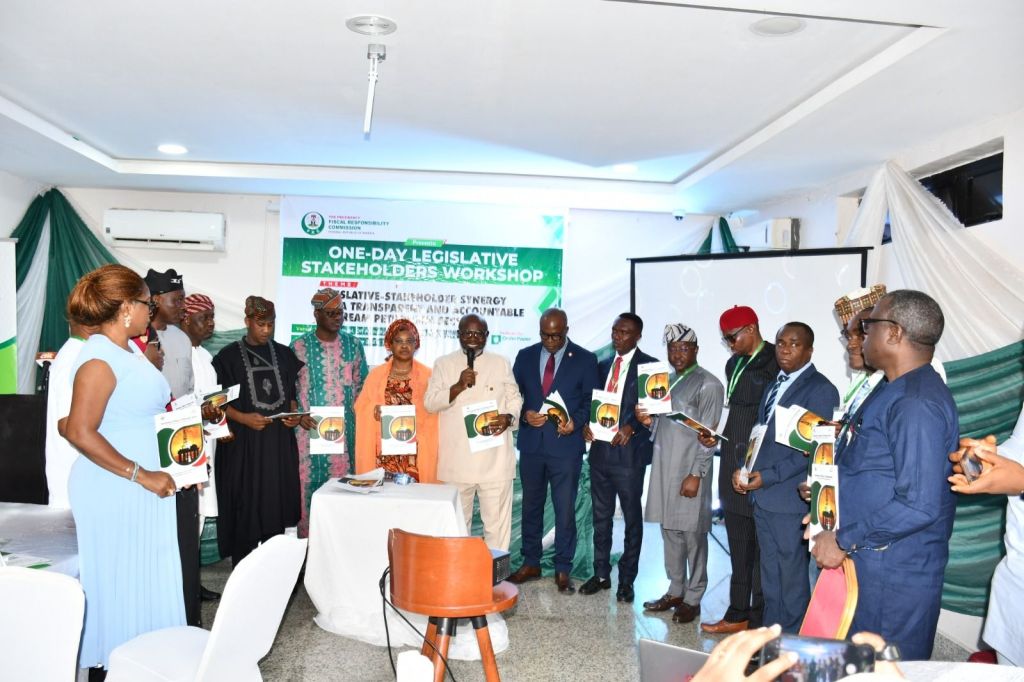
The Policy Paper proposes targeted reforms, enhanced reporting standards, deeper legislative oversight, and strengthened revenue accountability. It further outlines strategies to curb leakages, safeguard oil earnings, and ensure equitable distribution of petroleum revenues to support national development.
Stakeholders at the event described the document as a strategic tool capable of aligning Nigeria’s petroleum governance practices with global standards.
While acknowledging the gains of the Petroleum Industry Act (PIA) 2021 and ongoing reforms under President Bola Ahmed Tinubu’s administration, Muruako stressed the need for coordinated solutions to persistent sector challenges, including oil theft, pipeline vandalism, insecurity, and the integration of Environmental, Social, and Governance (ESG) principles.
Delivering Doguwa’s message, Hon. Ogbara reaffirmed the Committee’s commitment to strengthening the FRC to fully execute its mandate. She emphasized that the upstream sector remains central to national planning and investor confidence, noting that collaboration among institutions is essential to closing leakages and protecting Nigeria’s economic interests.
Ogbara also highlighted the Committee’s ongoing work on the Bill for an Act to Establish the National Commission for the Decommissioning of Oil and Gas Installations an initiative expected to address aging infrastructure, safety concerns, and environmental remediation.
The workshop attracted lawmakers, regulators, and industry experts, including representatives of RMAFC, NEITI, the Oil & Gas Free Zone Authority, and senior officials of the FRC.
Muruako urged participants to offer practical, solution-driven recommendations, stressing that Nigeria must manage its petroleum resources in the most fiscally responsible manner for the benefit of all citizens.

 Africa Security Investigation News