
Maryam Aminu
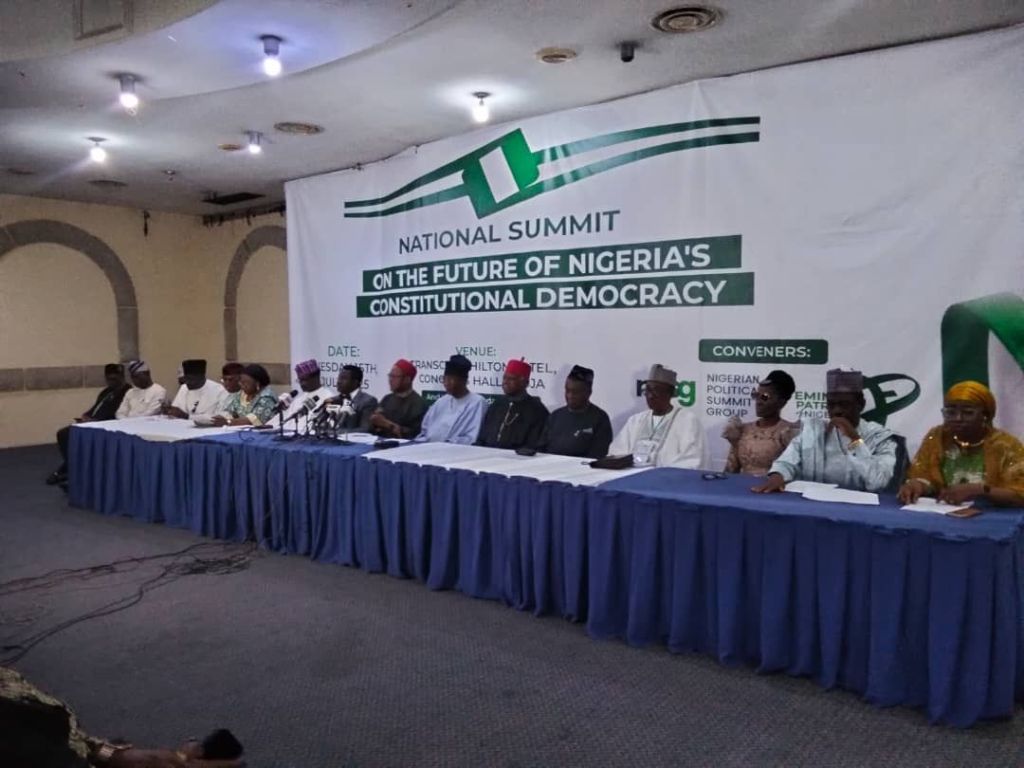
A strong call for a fresh constitutional order resonated from Abuja this week as the National Summit on the Future of Nigeria’s Constitutional Democracy concluded with far-reaching resolutions aimed at redefining Nigeria’s governance and future.
Convened by the Patriots, a group of eminent elder statesmen, in partnership with the Nigerian Political Summit Group (NPSG), the two-day summit held from July 16 to 17 brought together a broad coalition of stakeholders, including traditional leaders, youth and women organisations, civil society groups, academics, and professionals.
Addressing participants, the Convenor of the Summit and former Commonwealth Secretary-General, Chief Emeka Anyaoku, said the summit had critically assessed Nigeria’s current governance system under the 1999 Constitution.
He explained that the prevailing constitution was not a product of the people’s will and had failed to address the country’s longstanding governance challenges.
Anyaoku was quoted as saying that the existing constitution had weakened federalism, fostered ineffective governance, escalated insecurity, and deepened socio-economic disparities.
Participants at the summit reportedly agreed that a new Constitution was urgently needed. They recommended that it be drafted through a non-partisan National Constituent Assembly, to be elected and supervised by the Independent National Electoral Commission (INEC). They also resolved that such a Constitution should be subjected to a national referendum prior to being assented to by the President, in order to ensure popular legitimacy.
Stakeholders advocated for a return to true federalism, with a restructuring of the country into federating units aligned with the six geopolitical zones. They reportedly called for the devolution of powers from the central government to the sub-national levels to enhance efficiency and accountability.
The summit reportedly suggested a review of the presidential system of government, with a view to adopting a more cost-effective and sustainable governance model. Participants also proposed legislative and judicial reforms, which would include the establishment of special courts and the empowerment of federating units to create their own courts of appeal.
According to the communiqué, the summit further recommended the institutionalisation of independent candidacy, the introduction of strict anti-defection laws, and the full-scale implementation of electronic voting technologies to improve electoral transparency and credibility.
The summit emphasized the urgent need to drastically reduce the cost of governance, proposing a 75% cut in the number of government agencies and a limit on the size of ministerial and commissioner appointments.


Participants also called for robust anti-corruption reforms, including a thorough restructuring of the police and judiciary to ensure effectiveness and public trust.
On human development and inclusivity, the summit stressed the need to protect citizens’ rights, ensuring guaranteed access to education, security, and employment. Delegates also advocated for the inclusion of women, youth, and persons with disabilities in governance structures.
Additionally, the summit urged that Nigerians in the diaspora, estimated to be over 15 million, be granted voting rights in future elections.
On security matters, it was reported that the establishment of state police and the implementation of community-based policing were among the key recommendations aimed at tackling insecurity at the grassroots.
Participants backed the principle of fiscal federalism, urging that states be granted greater control over their natural and financial resources to foster local development and accountability.
Chief Emeka Anyaoku, in his closing remarks, expressed hope that the resolutions reached would serve as a blueprint for building a new Nigeria anchored on justice, equity, and shared prosperity.
He said that the summit aimed to ignite a national rebirth one in which no citizen is oppressed and every Nigerian child can dream and aspire to a better future.
The summit ended with a unified pledge from participants to continue advocating for the implementation of the resolutions as part of a broader effort to reform Nigeria’s constitutional democracy.

 Africa Security Investigation News