Emmanuel Daudu
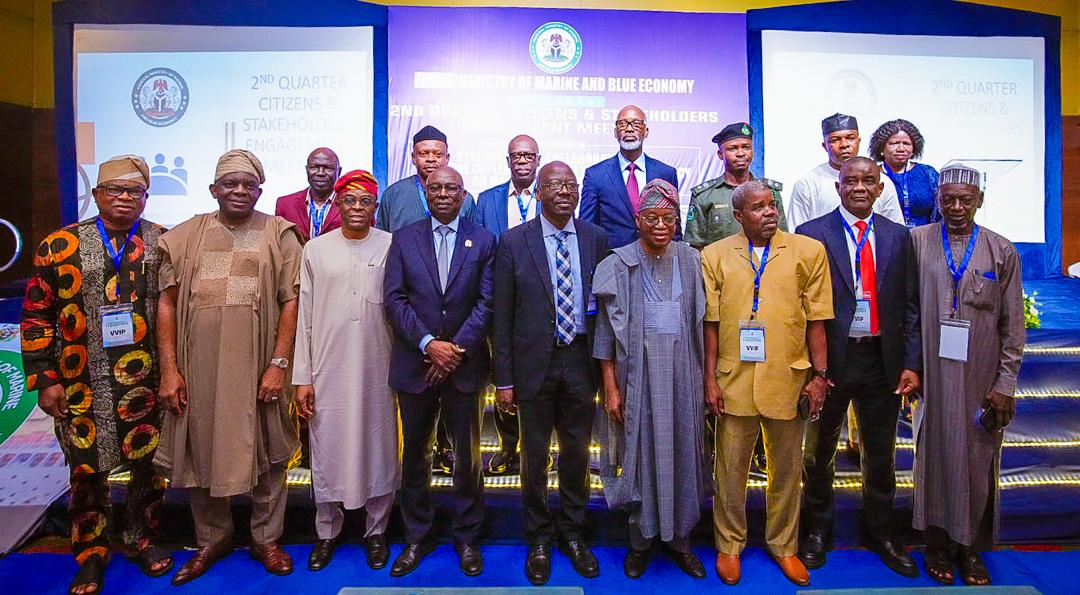
In a bold move to drive Nigeria’s marine sector transformation, the Honourable Minister of Marine and Blue Economy, Adegboyega Oyetola, on Wednesday led a high-level Citizens and Stakeholders Forum at Eko Hotels and Suites, Lagos, to accelerate the implementation of the National Policy on Marine and Blue Economy, recently approved by the Federal Executive Council.
Themed “Strengthening Collaboration for Effective Implementation of the National Policy on Marine and Blue Economy”, the forum brought together top players from government agencies, industry, academia, and civil society to forge a unified action plan for Nigeria’s marine ecosystem.
In his keynote, Oyetola hailed the creation of the Ministry as a strategic innovation under President Bola Ahmed Tinubu’s Renewed Hope Agenda, stating that the new policy provides a structured roadmap to unlock economic opportunities in maritime security, port infrastructure, ocean governance, coastal tourism, marine biotechnology, renewable energy, and aquaculture.
“This is not a ceremonial event but a practical working session to define institutional responsibilities and measurable outcomes,” Oyetola stressed, while calling for enhanced inter-agency coordination, accountability, and stakeholder inclusion.
He announced key developments, including the ongoing reconstruction of Apapa and Tin Can Ports and digital upgrades such as the Port Community System and a One-Stop-Shop port clearance system aimed at decongesting ports and boosting investor confidence.
The Minister also confirmed efforts to revive a National Shipping Carrier under a public-private partnership and the preparation for disbursing the Cabotage Vessel Financing Fund to strengthen indigenous shipping capacity.
Oyetola highlighted the Ministry’s 75% performance score in 2024, which placed it among the top-performing MDAs, and commended its Delivery Task Teams for driving this achievement despite structural challenges.
On inland waterways, he revealed that over 42,000 life jackets have been distributed and safety regulations enforced through the National Inland Waterways Authority (NIWA), reducing boat mishaps and restoring public trust in water transport.
Other key updates include the revival of fishing terminals, automation of licensing systems, and the Ministry’s digitisation efforts that have improved efficiency and revenue generation.
Oyetola also reaffirmed Nigeria’s commitment to regional maritime development with the operationalisation of the Regional Maritime Development Bank to be headquartered in Abuja.
Notably, he pointed to Nigeria’s successful maritime security strategy under the Deep Blue Project, which has kept piracy incidents at zero for three consecutive years, and noted Nigeria’s bid for a Category “C” seat on the International Maritime Organisation (IMO) Council.
Earlier, the Ministry’s Permanent Secretary, Mr. Olufemi Michael Oloruntola, welcomed participants and reiterated the Ministry’s commitment to inclusive policy implementation through quarterly stakeholder engagements.
He praised the Minister’s leadership and lauded ongoing reform efforts.
The forum featured active participation from leaders across maritime agencies, shipowners, terminal operators, freight forwarders, Customs, Navy, tech agencies, and women’s groups setting a strong foundation for collaborative and structured implementation of Nigeria’s Marine and Blue Economy Policy.

 Africa Security Investigation News