
By Adejoh Bilkisu
The Honourable Minister of Women Affairs, Hon. Imaan Sulaiman-Ibrahim, has marked her first 100 days in office with the unveiling of a series of transformative initiatives aimed at empowering women, strengthening child protection laws, and ensuring the inclusion of vulnerable groups in Nigeria’s development agenda.
Speaking at a press briefing in Abuja, the Minister stressed the need for a results-driven approach to addressing gender inequality, economic exclusion, and child welfare concerns.
She emphasized that the Ministry was committed to shifting from policy development to measurable impact, ensuring that Nigerian women and children were not left behind.
The Minister disclosed that the Ministry had set a target to economically empower 10 million women by 2027 in alignment with President Bola Ahmed Tinubu’s vision of a $1 trillion economy. She explained that to achieve this, several initiatives had been launched, including the Nigeria for Women Scale-Up Project, a World Bank-supported program aimed at equipping 4.5 million women across all 36 states and the FCT with financial literacy and business development skills.
She further revealed that the MOWA-SARA Accelerated Skills Acquisition Programme, in partnership with WEMA Bank, had been introduced to train 500,000 women in vocational skills, entrepreneurship, and financial inclusion. She noted that the first phase of the program was already underway in Kano State, where 2,500 women were currently receiving training.
The Minister also stated that plans were in place to establish a National Microfinance Framework for Women Entrepreneurs, which would provide affordable credit and investment opportunities for women-led businesses.
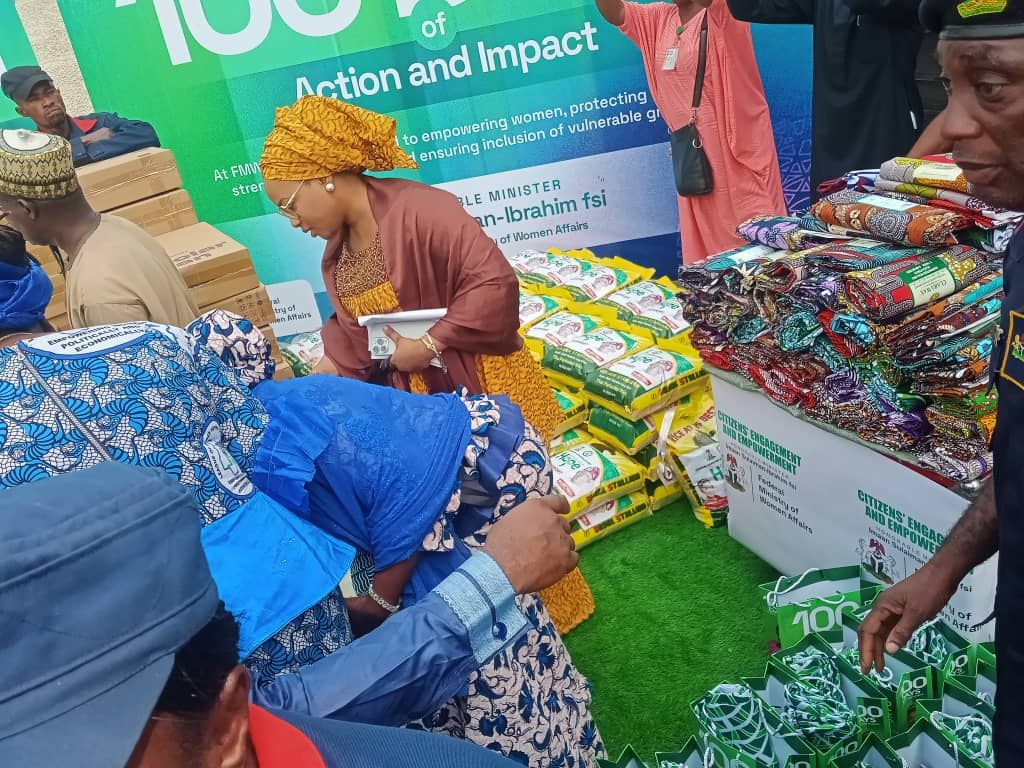

Acknowledging the economic hardship faced by many families, she announced that the Ministry had launched a Food Intervention Program to support women and vulnerable groups, ensuring that no woman or child was left behind.
Addressing child welfare concerns, the Minister revealed that efforts were being made to strengthen Nigeria’s child protection framework.
She announced that a Child Rights Act Review Committee had been set up to harmonize and modernize child protection laws, with a focus on implementing stricter penalties for child abuse, trafficking, and early marriage.
She added that nationwide consultations were being conducted to develop a National Child Protection Framework, which would provide a coordinated approach to safeguarding children.
She also disclosed that plans were underway for the establishment of a dedicated institution for Child Protection and Development, which would focus on implementing child welfare policies, strengthening protection services, and providing holistic support for vulnerable children.
As part of efforts to promote menstrual hygiene among young girls, the Minister revealed that the Ministry had launched a nationwide campaign targeting 10,000 girls with free hygiene kits to help them stay in school and maintain their dignity.
Speaking on Nigeria’s commitment to ending gender-based violence, she highlighted the country’s pledge at the Global Ministerial Conference on Ending Violence Against Children in Bogotá, Colombia, where it committed to providing comprehensive support services to two million children at risk of violence, abuse, and exploitation by 2030.
She added that Nigeria also aimed to deliver evidence-based parenting programs to 10 million families within the same period.
Sulaiman-Ibrahim further disclosed that Nigeria would take a leading role at the Commission on the Status of Women (CSW69) in New York, where the country would host six high-impact sessions on women’s leadership and empowerment, financial inclusion for women, and child protection rights.
She noted that this marked a shift from passive participation to active leadership in global gender advocacy.
Additionally, the Minister revealed that Nigeria was set to participate in COP29 in Azerbaijan, where it would advocate for gender-responsive climate action and work towards transitioning one million households to clean energy solutions.
The Minister underscored the importance of collaboration in achieving gender and social development goals, stating that the Ministry had strengthened engagement with state governments, particularly the Women Affairs Commissioners across the 36 states, to ensure better synergy and policy alignment. She also mentioned the formation of the High-Level Presidential Advisory Council on Women and Girls (HLAC), which would drive and coordinate gender-focused programs at the national level.
She highlighted that in the past 100 days, the Ministry had deepened partnerships with development organizations, civil society, and the private sector, fostering a multi-stakeholder approach to advancing gender equality, child protection, and social inclusion.
Hon. Sulaiman-Ibrahim called for stronger partnerships, faster implementation, and a unified approach to addressing gender and social development challenges.
She emphasized that the time for incremental progress was over and that bold action was required.
To commemorate the 100-day milestone, the Ministry distributed essential items, including wrappers, bags of rice, solar-powered devices, and other relief materials, to women and vulnerable groups.
The Minister noted that these donations were aimed at alleviating the economic burdens faced by many families and reinforcing the government’s commitment to improving the welfare of Nigerian women and children.
Reaffirming the administration’s commitment to gender equality, women’s empowerment, and child protection, the Minister described these initiatives as fundamental pillars of Nigeria’s economic and social development.
She called on government agencies, private sector partners, civil society organizations, and the international community to support efforts in accelerating gender-responsive policies, strengthening child protection mechanisms, and ensuring that no Nigerian woman or child was left behind.
With these reforms, she asserted that Nigeria was set to take a leadership role in global gender advocacy, ensuring that women and children remained at the center of national development efforts.
As the Ministry embarked on the next phase of its agenda, the Minister assured Nigerians that the government remained fully committed to delivering tangible results that would improve the lives of women, children, and vulnerable groups across the country.

 Africa Security Investigation News