Maryam Aminu
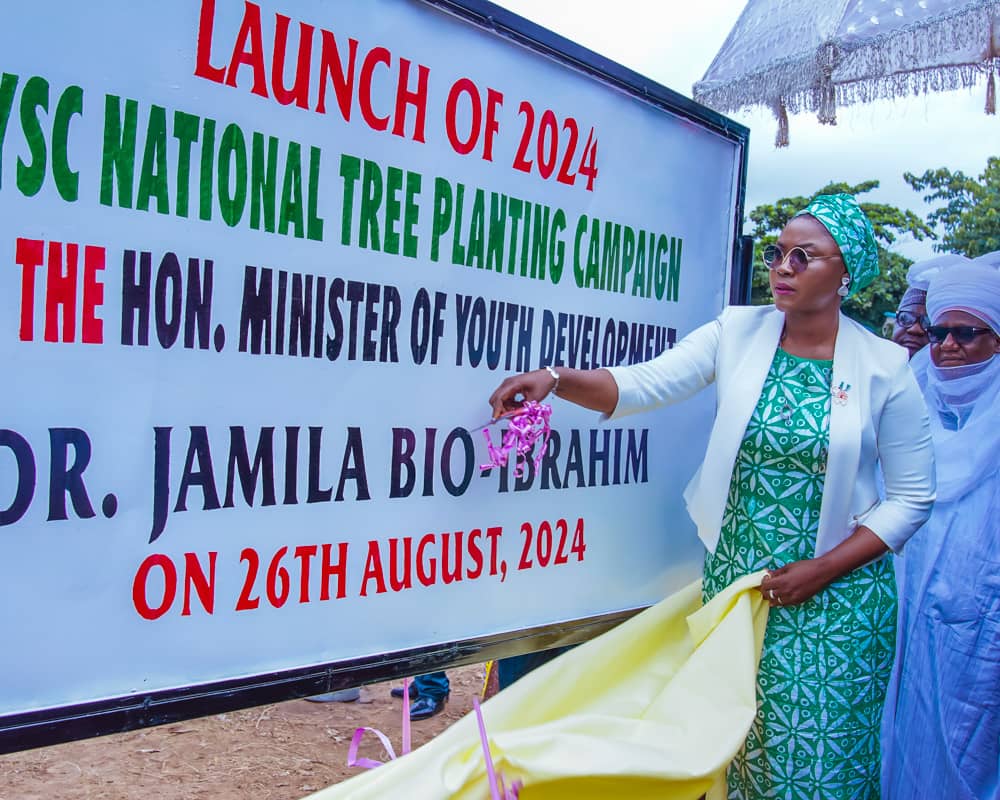
In a renewed effort to tackle climate change and environmental degradation, the Federal Government has directed all National Youth Service Corps (NYSC) members to plant a minimum of ten trees before their Passing Out Parade (POP). This directive was announced by the Minister of Youth Development, Dr. Jamila Bio Ibrahim, during the national flag-off of the NYSC tree-planting campaign at the permanent orientation camp in Keffi, Nasarawa State.
Dr. Bio Ibrahim highlighted the Federal Government’s partnership with the African Union Development Agency (AU-NEPAD) to lead this initiative, which aligns with President Bola Ahmed Tinubu’s commitment to planting 25 million trees by 2030. She emphasized the critical role of tree planting in mitigating climate change and encouraged corps members to use their creativity and energy to foster positive environmental changes in their communities.
“With around 400,000 corps members mobilized annually, the planting of 10 trees per person will result in four million new trees each year, achieving 20 million trees over five years. The NYSC, in collaboration with key stakeholders, is fully equipped to fulfill this ambitious goal,” Dr. Bio Ibrahim noted.
Addressing the urgency of the initiative, she pointed out that desertification has eroded Nigeria’s valuable
agricultural land, leading to conflicts over land use and creating challenges for farmers, herders, and communities.
“Climate change is profoundly impacting Nigeria, evident in the desertification in the north due to droughts and erosion in the south caused by floods,” she explained.
The Minister also highlighted the adverse effects of climatic variations on agricultural produce, air quality, and soil health, calling for collective action to protect the environment.
Dr. Bio Ibrahim stressed the importance of tree planting as an effective strategy to combat desertification, erosion, and other environmental challenges, including insecurity.
“Even small efforts can make a big difference in conserving the environment. However, the success of this endeavor relies on the energy and innovative spirit of our youths,” she added.
She called on all stakeholders, including community leaders and government agencies, to support the program to ensure a healthier environment for future generations.
Dr. Bio Ibrahim emphasized that Nigerian youth, with their creativity, energy, and commitment, are crucial to the project’s success, urging Corps members to harness these qualities to achieve the program’s goals.

 Africa Security Investigation News