Emmanuel Daudu
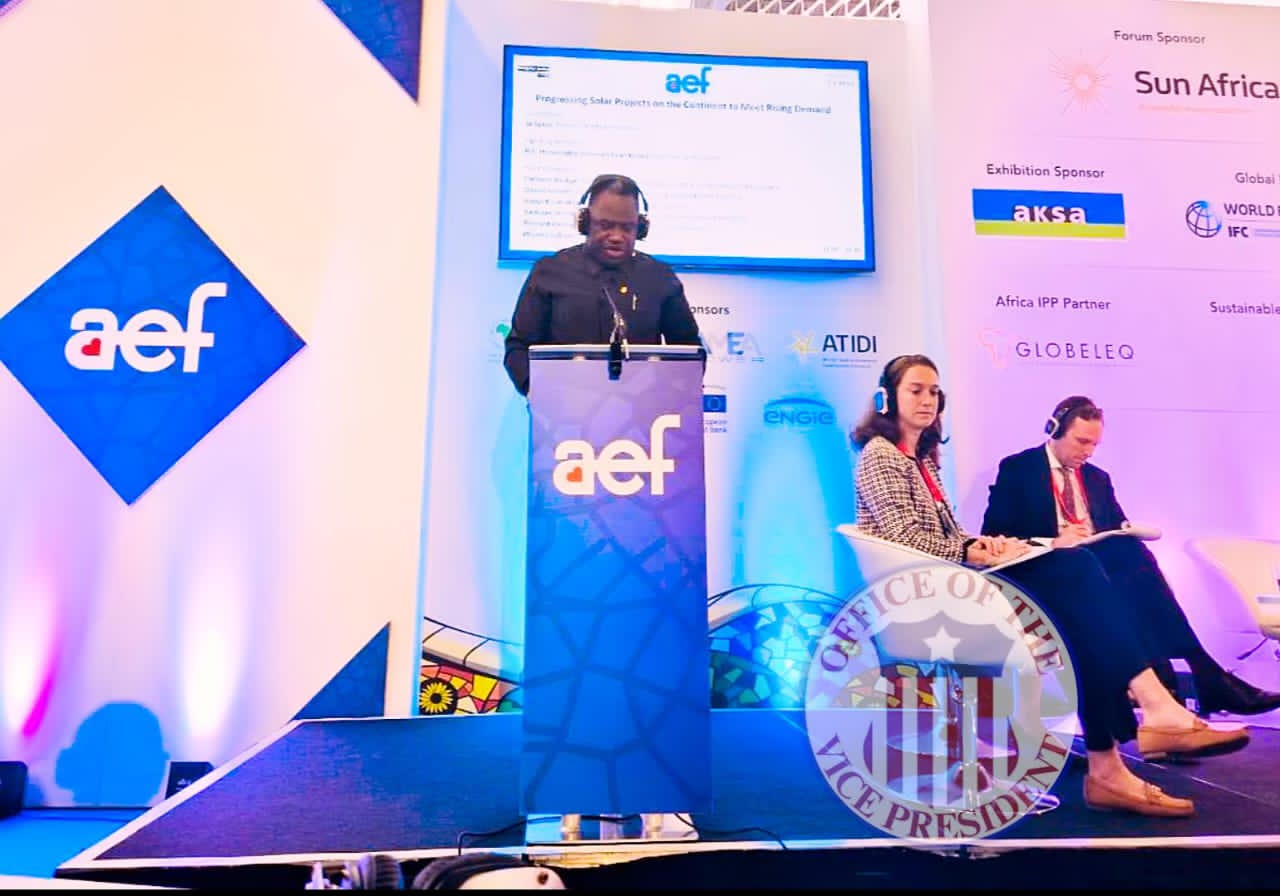
The Vice President of Liberia, Honorable Jeremiah Kpan Koung, has emphasized the critical need for advancing renewable energy projects across the continent.
Koung made the call while delivering an opening remarks at the Africa Energy Forum (AEF) on June 27, 2024 in Barcelona, Spain.
Representing President Joseph Nyumah Boakai, Sr., Vice President Koung highlighted the paradox of Africa’s rich energy resources and its status as the most energy-deficient continent.
In his speech, Koung addressed the urgency of tackling global warming and the detrimental impact of carbon emissions from fossil fuels.
He underscored the importance of the Paris Climate Agreement, advocating for limiting global temperature rise to 1.5 degrees Celsius above preindustrial levels and integrating renewable energy into national climate action plans.
“Renewable energy is the prime mitigation against carbon emissions caused by fossil-fuel-based power generation,” Koung stated.
He called for increased investment in renewable energy, citing the United Nations’ recommendation of at least $4 trillion annually until 2030 to achieve net-zero emissions by 2050.
He also urged developed nations, the primary contributors to pollution, to play a substantial role in global cleanup and mitigation efforts.
Highlighting Liberia’s commitment to renewable energy, Koung detailed the country’s potential for solar and hydropower projects. Liberia’s tropical climate and high solar radiation levels make it an ideal candidate for solar energy development. Koung announced plans for a 25 Megawatt solar farm and a 16 Megawatt SCATEC solar project near the existing hydropower station, aiming to secure over 60 Megawatts of solar power to prevent dry season blackouts.
Liberia’s roadmap to a low-carbon economy includes developing the nearly 150 Megawatts St Paul River basin as a key component of its strategy.
The Vice President emphasized the nation’s readiness to achieve net-zero carbon emissions by 2050, highlighting the liberalization of the power sector and the establishment of an independent electricity regulatory body to attract private sector participation.
Koung also pointed to the West Africa Power Pool (WAPP), which connects Liberia with neighboring countries, facilitating the easy evacuation of Independent Power Producers (IPPs).
He invited private sector investors, equipment manufacturers, and European power companies to join Liberia in its renewable energy initiatives through public-private partnerships.
“Our initiatives provide an enabling environment for IPPs to help us construct and operate the St Paul River hydropower project,” Koung concluded.
“We invite the private sector to join us on this journey to our mutual benefit as we save our planet.” He added
Emmanuel Daudu
The Vice President of Liberia, Honorable Jeremiah Kpan Koung, has emphasized the critical need for advancing renewable energy projects across the continent.
Koung made the call while delivering an opening remarks at the Africa Energy Forum (AEF) on June 27, 2024 in Barcelona, Spain.
Representing President Joseph Nyumah Boakai, Sr., Vice President Koung highlighted the paradox of Africa’s rich energy resources and its status as the most energy-deficient continent.
In his speech, Koung addressed the urgency of tackling global warming and the detrimental impact of carbon emissions from fossil fuels.
He underscored the importance of the Paris Climate Agreement, advocating for limiting global temperature rise to 1.5 degrees Celsius above preindustrial levels and integrating renewable energy into national climate action plans.
“Renewable energy is the prime mitigation against carbon emissions caused by fossil-fuel-based power generation,” Koung stated.
He called for increased investment in renewable energy, citing the United Nations’ recommendation of at least $4 trillion annually until 2030 to achieve net-zero emissions by 2050.
He also urged developed nations, the primary contributors to pollution, to play a substantial role in global cleanup and mitigation efforts.
Highlighting Liberia’s commitment to renewable energy, Koung detailed the country’s potential for solar and hydropower projects. Liberia’s tropical climate and high solar radiation levels make it an ideal candidate for solar energy development. Koung announced plans for a 25 Megawatt solar farm and a 16 Megawatt SCATEC solar project near the existing hydropower station, aiming to secure over 60 Megawatts of solar power to prevent dry season blackouts.
Liberia’s roadmap to a low-carbon economy includes developing the nearly 150 Megawatts St Paul River basin as a key component of its strategy.
The Vice President emphasized the nation’s readiness to achieve net-zero carbon emissions by 2050, highlighting the liberalization of the power sector and the establishment of an independent electricity regulatory body to attract private sector participation.
Koung also pointed to the West Africa Power Pool (WAPP), which connects Liberia with neighboring countries, facilitating the easy evacuation of Independent Power Producers (IPPs).
He invited private sector investors, equipment manufacturers, and European power companies to join Liberia in its renewable energy initiatives through public-private partnerships.
“Our initiatives provide an enabling environment for IPPs to help us construct and operate the St Paul River hydropower project,” Koung concluded.
“We invite the private sector to join us on this journey to our mutual benefit as we save our planet.” He added

 Africa Security Investigation News