Bilkisu Adejoh
A number of about 50 civil society organisations have condemned corrupt practices in Nigeria and decried the malicious attacks on anti-corruption agencies
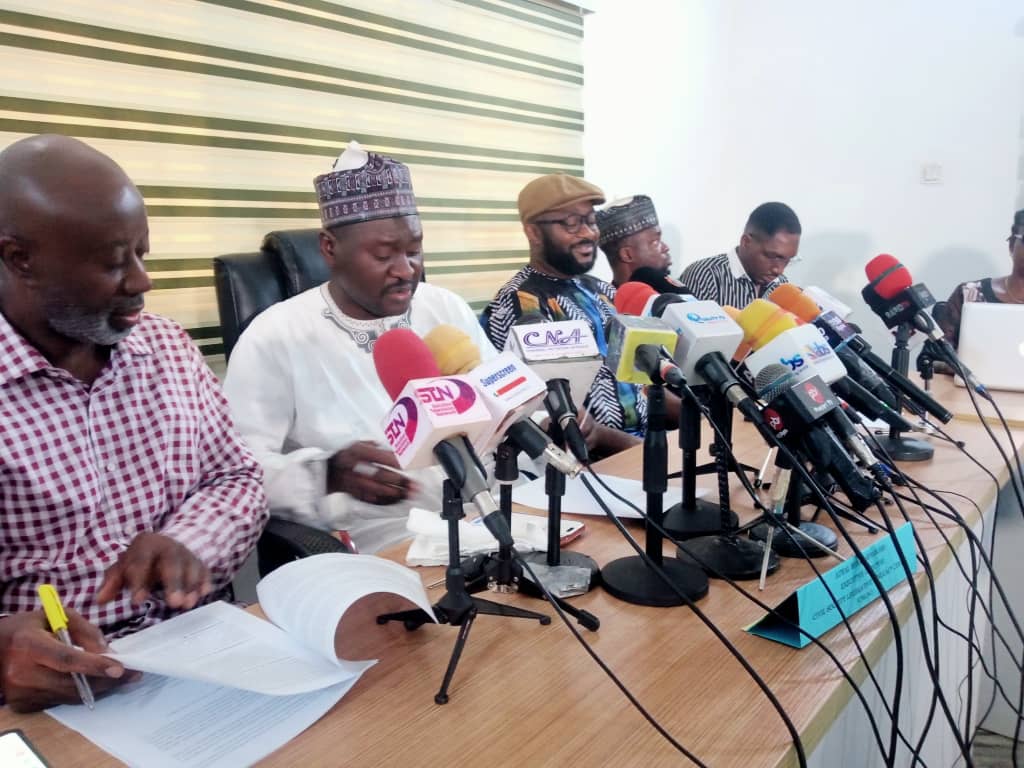
Auwal Ibrahim Musa (Rafsanjani), Executive Director of the Civil Society Legislative Advocacy Centre (CISLAC), who spoke at a press conference in Abuja on Thursday on behalf of other CSOs, said transparency and accountability are crucial elements that enable democracies to flourish.
Rafsanjani lamented that democracy in Nigeria has persistently functioned under a veil of secrecy and lawlessness.
The groups faulted President Bola Ahmed Tinubu for appointing politicians facing corruption allegations into his cabinet
“We urge the ruling All-Progressive Party APC and other political parties to take decisive action in purging its ranks by denouncing and breaking support with their members who are currently being investigated by anti-corruption agencies,” they said.
“This can be operationalised by suspending all members tainted by corruption allegations and ensuring they are held accountable before the law.
“Procurement of political appointments by some suspected or investigated looters who are serving under the current administration as ministers, legislators, or occupying leadership positions of the ruling party, has exposed anti-corruption work to serious setbacks and deliberate sabotage that cripple the efficiency of the anti-corruption agencies.
The CSOs expressed that many serving lawmakers and ministers have corruption allegations against them. This is producing a culture of impunity, where politicians engage in corrupt practices without fear of consequences
The CSOs further expressed with sadness the malicious attacks and deliberate efforts to blackmail anti-corruption agencies through sponsorship of influencers, incentivised opinion publications in some national dailies, online and electronic platforms, all targeted at discouraging anti-corruption efforts and shielding the kleptocrats from a thorough investigation”.
The pattern is clear, there is an unfolding plot of surreptitious moves to backpedal on the progress made by anti-corruption progress,” they said.
According to the CSOs, judicial corruption constitutes a major challenge to anti-corruption work in Nigeria.
The looters have repeatedly used their influence to manipulate the judicial process and system, to block and/or delay the arrest or prosecution of suspects,” he said.
“Clearly, the judiciary is not living up to its responsibility of ensuring that the rule of law and provisions of the constitution are upheld.
“Nigerians have witnessed too many situations where courts have granted injunctions which deterred anti-corruption agencies from inviting and prosecuting corrupt government officials and politically exposed persons.
They also added that Nigerians have witnessed with alarm numerous cases featuring a high number of foreign enablers from Switzerland, Monaco, Panama, British Virgin Islands and the United Kingdom (UK) facilitating corruption. Enablers from the UK are particularly strongly linked to Nigerian cases. Of course, Nigeria also has a number of domestic enablers involved in cases. Out of 87 enablers captured, 5 enablers are from Nigeria: 3 lawyers/law firms and 2 real estate agents. This is due to cases involving, for example, Nigerian lawyers managing trusts on behalf of their clients that are then used to move funds abroad
The groups also noted that the budgetary allocations to the Economic and Financial Crimes Commission (EFCC), Independent Corrupt Practices and Other Related Offences Commission (ICPC), Code of Conduct Bureau (CCB) and Nigeria Police, among others are inadequate.
“Poor resource allocation is a calculated attempt to gradually push these agencies towards extinction. By limiting their resources, the government is effectively crippling their ability to function effectively and independently,” said the CSOs.
“There are desperate efforts by corrupt elements to disinform, mislead, misinform and confuse Nigerians on the efforts of various anti-corruption institutions in Nigeria.
“We are worried over the poor understanding of the work and mandates of the anti-corruption agencies by many Nigerians including the youth.”
Suggesting ways to curb corruption the groups said to effectively combat corruption and make significant strides towards progress, it is crucial to adopt a cohesive strategy that addresses all elements that support Nigeria’s growing corruption system.
“The National Judicial Council must diligently monitor its members and promptly remove any corrupt judicial officer found to be compromising the judicial system. By doing so, it will significantly contribute to the restoration of sanity and the promotion of accountability within the nation.
“To truly establish a flourishing democracy, transparency and accountability must be strictly adhered to in governance.
“We urge IGP Kayode Egbetokun to promptly reinstate the police personnel withdrawn from the Kano State Anti-Corruption Commission, to facilitate the effective execution of Commission’s duties. Nigeria Police must avoid actions that may portray it as being submissive to politicians”, the CSOs added.
The Civil Society Organisations represented at the press conference were Civil Society Legislative Advocacy Centre (CISLAC), Human and Environmental Development Agenda (HEDA Resource Centre), Resource Centre for Human Rights and Civic Education (CHRICED), Centre for Information Technology and Development (CITAD), African Centre for Media & Information Literacy (AFRICMIL), Borno Coalition for Democracy and Progress (BOCODEP), BudgIT Foundation, Corporate Accountability and Public Participation Africa (CAPPA), State of the Union (SOTU), Tax Justice and Governance Platform, Transition Monitoring Group (TMG), Women in Media Communication Initiative (WIM), Zero Corruption Coalition (ZCC), Alliance for Credible Elections (ACE), Centre Democracy and Development (CDD) and Accountability Lab, Nigeria.
Others include Centre for Journalism Innovation and Development (CJID), Say NO Campaign, Femi Falana Chamber, Health of Mother Earth Foundation (HOMEF), Socio-Economic Rights and Accountability Project (SERAP), Good Governance Team, 21st Century Community Empowerment for Youth Initiative, OCCEN-Kano, Mothers and Marginalised Advocacy Centre (MAMA Centre), Social Action, Centre for Transparency Watch, West Africa Civil Society Forum WASCSOF, Global Rights, African Centre for Leadership, Strategy & Development (Centre LSD), Partners West Africa, Order Paper, Environmental Rights Action/Friends of the Earth, Nigeria, Center for Fiscal Transparency and Public Integrity, Amnesty International Nigeria, Rule of Law and Accountability Advocacy Centre RULAAC, Connected Development (CODE), Centre for Democratic Research and Training (CRDDERT), Praxis, CLEEN Foundation, Spaces for Change, Abuja School of Social and Political Thought, Yiaga Africa, Policy Alert, Socio Economic Research and Development Centre, Procurement Observation and Advocacy Initiative, Media Rights Agenda and Centre for Social Justice.

 Africa Security Investigation News