By Emmanuel Daudu
NiMet has advised farmers to take necessary precautions in order to mitigate the impact of the below-normal rainfall, while urging residents in states with above-normal rainfall predictions to be prepared for possible flooding and take necessary safety measures.
The Agency stated that there is a likelihood of above-normal rainfall over parts of Sokoto, Zamfara, Katsina, Kaduna, Niger, FCT, Kwara, Oyo, Ogun, Ekiti, Osun, Ondo, Edo, and Rivers states. The agency also warned of the possibility of flooding in some states during the rainy season.




It also emphasized the importance of early monitoring, preparedness, and response to extreme weather events in order to minimize the potential impact on lives and property. NiMet urged individuals and communities to heed weather warnings and advisories and stay informed about changing weather conditions throughout the season.
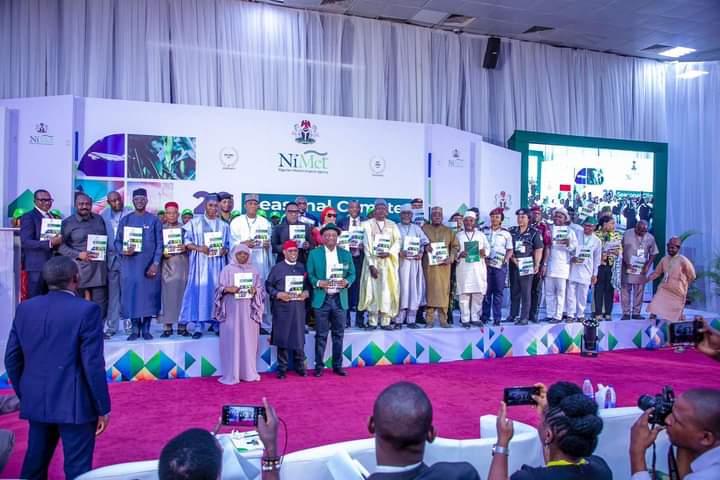
The event themed: Facilitating a Weather Resilient Economy through Early Warnings for All to Forster Renewed Hope and Sustainable Development, NiMet held the annual event on Tuesday in Abuja disclosed further that other parts of the country would likely observe normal to above-normal annual rainfall amounts.
The prediction also showed that in July, there would be a likelihood of a severe dry spell that may persist for more than 15 days after the onset of rainfall across the country.
States in the country to be likely affected by the dry spell would be Oyo, Ogun, Osun Edo, Enugu, Anambra, and parts of Cross Rivers.
The Minister of Aviation and Aerospace Development, Festus Keyamo, while unveiling the report for the 2024 SCP said that the onset of rains in 2024 was predicted to be delayed in some parts of the country, especially the North Central States.
Keyamo said: “A normal onset is likely to occur over the northern states.
“Borno, Abia, and Akwa Ibom states are predicted to have an early onset when compared to their long-term averages.
“An early end of the season is predicted for parts of Yobe, Jigawa, Sokoto, Kebbi, Kano, Kaduna, Plateau, Nasarawa Taraba, Gombe, Bauchi, Cross River, Ebonyi, Ogun, and Lagos states.
“A late cessation is predicted over the southern states of Bayelsa, Rivers, Akwa Ibom, Ondo, Ekiti, and parts of Edo, Delta, Ogun, Oyo, Kogi, Kwara, FCT, Niger, and Kaduna.”.
Keyamo said the annual rainfall amount was predicted to be below normal over parts of Yobe, Jigawa, Bauchi, Kano, Kebbi, Gombe, Plateau, Taraba, Nasarawa, Benue, Enugu, Ebonyi, Cross River, Delta, and Bayelsa states when compared to their long-term normal.
In the 2024 SCP, other parts of the country are likely to observe normal to above-normal annual rainfall amounts.
Meanwhile, the World Meteorological Organization commended NiMet for the consistently producing the Seasonal Climate Prediction for the past 10 years since 2013.
WMO said that the development of Early Warning Systems to cover everyone on the planet by 2027 was now a priority of the United Nations.
WMO’s representative at the meeting appealed to the Federal Government of Nigeria to pursue the development of a National Framework for Weather, Water, and Climate Services, with a vibrant User Interface Platform for effective engagement and contribution of stakeholders to the production and utilization of Early Warning in the country.
WMO said the Seasonal Climate Prediction produced by NiMet was a contribution to Early Warning which should be embraced and utilized by all stakeholders in planning and implementation of activities in support of disaster risk management and sustainable development in Nigeria.
The WMO observed that the World Economic Forum in 2024 ranked extreme weather as the highest current risk facing the global economy.
WMO said: “Extreme weather is expected to remain the highest risk over the next 10 years together with critical change to Earth systems, biodiversity loss and ecosystem collapse, and natural resource shortages.
“The year 2023 has been confirmed as the hottest on record and the past nine years, 2015 to 2023, were the hottest on record. This trend has continued in 2024 with January confirmed as the hottest January on record.
“The impact of climate change is being felt across the globe and most especially in Africa.
“More than 1p10 million people on the African continent were directly affected by weather, climate and water-related hazards in 2022, causing more than 8.5 billion dollars in economic damages.”

 Africa Security Investigation News