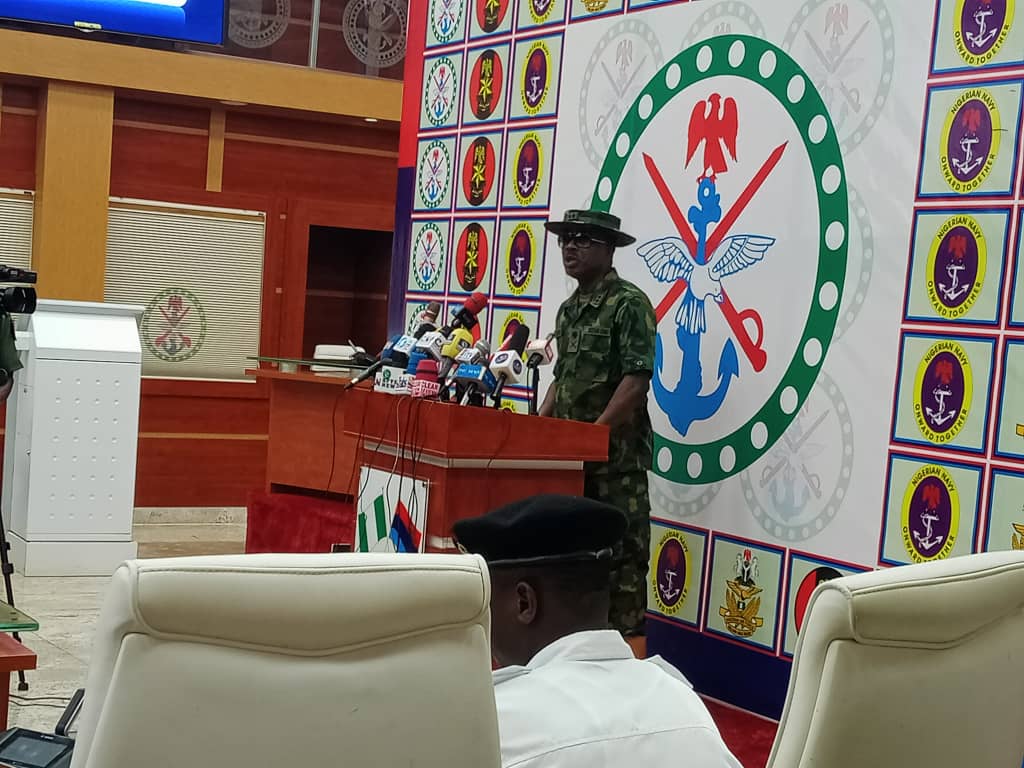
Armed Forces of Nigeria Strike Terror Havens, Recover Arms and Rescue Hostages in Bold Operations

Emmanuel Daudu

In a series of relentless operations across Nigeria’s conflict zones, the Armed Forces have made remarkable strides in counterterrorism efforts, conducting operations that neutralized terrorists, dismantled criminal networks, and rescued kidnapped hostages.

The operations, spanning the country’s North East, North Central, North West, and South-South regions, are part of ongoing campaigns to restore peace and security.

The Director Defense Media Operations Major General Edward Buba, made this known in a statement he signed and made available to journalists today in Abuja

Troops under Operation HADIN KAI scored significant victories against Boko Haram (BH) and Islamic State West Africa Province (ISWAP) terrorists.

“Over the week, 74 terrorist fighters, including combatants and their families, surrendered to Nigerian forces.”

Major Buba noted that operations across Borno, Yobe, and Adamawa states also led to the arrest of 29 suspected terrorist collaborators.

In various fierce battles, troops neutralized 54 terrorists, arrested 71 suspects, and rescued 39 hostages.

‘Military hardware recovered during these engagements included 18 AK-47 rifles, fabricated firearms, and significant rounds of ammunition.” Said Major Buba

One of the high points was an air interdiction mission targeting terrorist hideouts in Bukar Meram, which saw several insurgents killed and their logistical hubs destroyed.

He further disclosed that the North Central region, troops of Operation SAFE HAVEN intensified counter-kidnapping and anti-terror operations in Plateau and Kaduna States.

“The troops arrested 36 extremists, neutralized 5, and rescued 46 kidnapped victims. Among the seized items were a cache of firearms, including locally fabricated guns, and rounds of ammunition. The operation’s success was bolstered by swift responses to distress calls from vulnerable communities.

The war against terror was also active in the North West, where Operation HADARIN DAJI troops responded to terrorist threats in Zamfara, Katsina, and Kaduna states.

He revealed that troops neutralized 25 terrorists, rescued 32 hostages, and arrested 29 extremists.

The operations resulted in the recovery of 8 AK-47 rifles, fabricated weapons, hundreds of rounds of ammunition, and motorcycles used by the terrorists for their attacks.

In an air strike targeting terrorist enclaves in Zamfara State, several insurgents were eliminated, further crippling their operational capacities.

The Director Defence Media operations explained that the troops under Operation DELTA SAFE continued their campaign against oil theft and illegal refineries, seizing over 700,000 liters of stolen crude oil.

They arrested violent extremists and kidnappers across Akwa Ibom, Delta, and Edo States.

The operation also destroyed 34 illegal refining sites, marking a significant blow to oil thieves in the region. The air component played a critical role by targeting and destroying storage tanks, reservoirs, and barges linked to the illicit activities.

Across the various operations, the Nigerian military’s unified approach, backed by air interdiction missions, has led to a notable decline in insurgent activities.
.
The combined forces neutralized a total of 99 terrorists, arrested 170 suspects, and rescued 138 hostages.

“These operations underscore the determination of the Nigerian Armed Forces to eliminate terror threats and restore peace to the nation’s troubled regions.

The military remains committed to sustaining these gains, with continued operations aimed at rooting out the remnants of terror groups and ensuring a safer Nigeria.

CSOs Slam Governors’ Actions, Call for Sanctions Over Threat to Anti-Corruption Efforts and Local Government Autonomy

Adejoh Bilkisu

A coalition of civil society organizations (CSOs) focused on anti-corruption and good governance has strongly criticized the actions of several state governors, warning that their efforts undermine Nigeria’s fight against corruption and threaten the financial autonomy of local governments a key pillar of grassroots democracy.

During a joint press conference in Abuja, Auwal Ibrahim Musa (Rafsanjani), Executive Director of the Civil Society Legislative Advocacy Centre (CISLAC), condemned the legal actions initiated by 16 state governors to challenge the authority of anti-corruption bodies such as the Economic and Financial Crimes Commission (EFCC) and the Nigerian Financial Intelligence Unit (NFIU).

The governors have filed a suit at the Supreme Court, seeking to strip these agencies of their powers at the state level.

“These governors are hiding behind legal technicalities to challenge the legality of institutions like the EFCC, which has effectively operated for over two decades under Nigerian law. Their actions undermine the anti-corruption fight and send a dangerous message that accountability can be sacrificed for political convenience,” Rafsanjani said.

The suit, slated for hearing on October 22, 2024, seeks to prevent the EFCC and NFIU from issuing directives or investigating funds allocated to state and local governments. The governors argue that the EFCC Act is unconstitutional because it was not ratified by state Houses of Assembly, citing Section 12 of the 1999 Constitution related to treaties.

However, Rafsanjani refuted this argument, stressing that the EFCC Act is a national law designed to combat corruption, not a treaty.

He warned that Nigeria risks being blacklisted by the Financial Action Task Force (FATF), which has already placed the country on its grey list for non-cooperation in global efforts against money laundering.

The coalition, which includes 43 prominent CSOs such as Yiaga Africa, Connected Development (CODE), Amnesty International Nigeria, BudgIT Foundation, and the Africa Network for Environment and Economic Justice (ANEEJ) etc, called on the Federal Government and the National Assembly to impose sanctions on any governor violating the financial autonomy of local governments.

The CSOs noted that a recent Supreme Court ruling affirmed the financial independence of local governments, which is crucial for delivering essential services and fostering grassroots development. Despite this ruling, some governors continue to interfere with local government finances and have introduced bills to undermine the court’s decision.

Speaking further, Hamzat Lawal, Chief Executive of Connected Development CODE, emphasized that the fight against corruption is a collective responsibility.

“Institutions like the EFCC, ICPC, and NFIU are essential to winning this fight. Any attempt to render these institutions ineffective is a disservice to Nigeria,” Lawal said.

He called on the governors to withdraw their lawsuit and work collaboratively with anti-corruption agencies to promote transparency and accountability in their states.

He also urged the government to strengthen these institutions by providing them with the necessary resources and ensuring their independence.

“We reject any attempt to weaken Nigeria’s anti-corruption framework and call on all Nigerians to join us in defending the integrity and effectiveness of these agencies,” the coalition declared.

They expressed acall for action from all arms of government executive, judiciary, and legislature to reinforce the country’s anti-corruption efforts for the benefit of all Nigerians.

Rt.Hon. Abbas Decries Poor Funding of NSCC, Pledges Partnership to Strengthen Senior Citizen Care

Adejoh Bilkisu
.
In a significant development, the Speaker of the House of Representatives, Rt. Hon. Tajudeen Abbas, has expressed concerns over the inadequate funding of the National Senior Citizens Centre (NSCC), noting its limited budget allocation of N450 million for 2024.

Despite the financial constraints, Abbas lauded the NSCC’s achievements in its first three years of operation, recognizing its critical role in addressing the needs of Nigeria’s aging population.

Speaking during a meeting with the NSCC’s Director General, Dr. Emem Omokaro, and her team at his office, Rt. Hon. Abbas acknowledged the center’s progress and promised increased legislative support to ensure the actualization of its mandate.

He emphasized the need for improved funding in the 2025 budget to enable the NSCC to provide essential services to senior citizens across the country’s 774 local government areas.

Abbas highlighted the unique position of the NSCC as the sole government agency focused on aging issues and pledged the House’s commitment to bolstering its capacity.

He assured Dr. Omokaro of future collaborations aimed at enhancing pension governance, healthcare delivery for seniors, and creating age-friendly environments nationwide.

The Speaker mentioned plans to establish NSCC offices in Nigeria’s six geopolitical zones.

Dr. Omokaro, in her remarks, expressed gratitude to the National Assembly for passing the National Senior Citizens Centre Act in 2017, which she described as a landmark shift in the inclusion of older persons in Nigeria’s national development agenda.

However, she raised concerns about the persistent underfunding of the center, urging the House to champion the National Plan of Action on Aging and ensure that ministries and government agencies prioritize projects directly benefiting older citizens.

The Director General further advocated for the establishment of a regulatory framework for the geriatric social care sector.

She also called for the training and certification of at least 250 caregivers in each state, noting the current reliance on unskilled workers in senior care.

With the House of Representatives pledging to address these challenges, the partnership between the legislature and the NSCC could mark a turning point in Nigeria’s efforts to improve the well-being of its aging populati

Defence Minister Expresses Heartfelt Condolences to Jigawa State Over Tragic Fuel Tanker Explosion

Emmanuel Daudu

The Honourable Minister of Defence, His Excellency Mohammed Badaru Abubakar, has expressed deep sorrow over the devastating fuel tanker explosion that claimed over 90 lives and left more than 50 injured in Majiya Town, Taura Local Government Area of Jigawa State.

In a statement released on Wednesday, October 16, 2024, the Defence Minister extended his heartfelt condolences to the Government and the people of Jigawa State, while offering words of comfort to the families of the victims.

“I am deeply saddened by the tragic fuel tanker explosion that claimed precious lives and left many injured. My heart goes out to the people of Jigawa State during this difficult time,” said the Minister.

“I pray that the souls of the departed rest in peace, and may Almighty God grant their families the strength and fortitude to bear this irreparable loss. May the injured recover quickly and fully.”

The explosion, which occurred on Tuesday night, has left the community reeling from the tragic loss of life, and the Defence Minister’s message of support comes as the nation mourns alongside Jigawa.

The Minister’s expression of sympathy underscores the government’s commitment to standing by affected communities in times of disaster.

This incident, one of the deadliest in recent memory, has raised concerns about safety protocols and emergency preparedness in rural areas where such disasters often have catastrophic effects.

Local authorities have begun investigations to determine the cause of the explosion, while efforts to provide medical aid to survivors are ongoing.

Matawalle and Sokoto Governor Inspect Critical NAF 119 Composite Group Project in Sokoto

Emmanuel Daudu

In a move that underscores the Federal Government’s unwavering commitment to national security, the Honourable Minister of State for Defence, Dr. Bello Muhammad Matawalle, MON, alongside the Executive Governor of Sokoto State, Alhaji Ahmed Aliyu Sokoto, Ph.D., FCNA, conducted a joint inspection of the ongoing Nigerian Air Force (NAF) 119 Composite Group (CG) project in Sokoto State.

The site visit, aimed at assessing progress on the key NAF infrastructure, saw Dr. Matawalle laud the professionalism and dedication of the personnel involved.

He emphasized the pivotal role NAF plays in safeguarding Nigeria, especially in countering insurgency and other security threats in the North-West.

“The Nigerian Air Force continues to play a critical role in safeguarding our nation,” the Minister affirmed.

“The Federal Government is committed to ensuring that NAF has the necessary resources to enhance operational efficiency as we intensify the fight against insecurity.”

Governor Aliyu Sokoto echoed the Minister’s sentiments, praising the Federal and State Government’s collaboration in addressing the complex security challenges facing Sokoto State and the wider region. “Sokoto State stands firmly with the Armed Forces,” the Governor declared. “We will continue to support all efforts aimed at achieving peace and stability for our people.”

The Governor further commended Minister Matawalle for his determination and personal commitment to restoring security in the North-West.

“The Minister has shown exceptional resilience and bravery by penetrating areas previously considered no-go zones and facilitating the return of communities to regions once deserted,” Governor Sokoto noted.

The briefing on the project’s progress was delivered by the Unit Commander, with the GOC 8 Division, Brigadier General I.A. Ajose, and other senior military officials in attendance. The NAF 119 Composite Group project is viewed as a vital component in bolstering NAF’s operational capabilities in the North-West, a region historically plagued by banditry and insurgency.

This joint inspection highlights the ongoing efforts by both Federal and State Governments to strengthen military infrastructure in critical regions, with the NAF 119 CG project set to be a cornerstone in securing peace and stability in Sokoto and beyond.

Badaru Calls for Strategic Synergy in Nigeria’s Defence Sector, Focuses on Technology and Local Innovation

Emmanuel Daudu

Nigeria’s Minister of Defence, Mohammed Badaru Abubakar, has reaffirmed the government’s determination to enhance the country’s military capabilities through cutting-edge technology and innovation.

Speaking at the Defence Research and Development Bureau’s (DRDB) Annual Seminar and Exhibition in Abuja, the Minister called for greater synergy within Nigeria’s defence sector to foster a Military Industrial Complex capable of responding to evolving security threats.

At the event, themed “Enhancing Synergy in R&D Towards a Robust Military Industrial Complex in Nigeria,” Badaru emphasized that collaboration and local production are key to Nigeria’s defence strategy.

He noted that the Federal Government is committed to advancing Research and Development (R&D) in the defence sector, which is seen as vital in addressing global and regional security challenges.

“Our national security strategy acknowledges the vital role of innovation in fostering a secured and prosperous nation,” the Minister said. “To effectively respond to today’s dynamic threats, we must integrate a Military Industrial Complex that promotes self-reliance and local production of military equipment.”

Badaru highlighted President Bola Ahmed Tinubu’s Renewed Hope Agenda and stressed the importance of the Defence Industries Corporation of Nigeria (DICON) Bill of 2023 in advancing Nigeria’s defence production capabilities.

The seminar aimed to promote collaboration among key stakeholders in the defence sector, from government agencies to private industry partners. According to Badaru, such partnerships are essential for building a robust military capable of withstanding new threats. “It is through collaboration and cooperation that we can harness cutting-edge technologies and stay ahead of emerging threats,” he said.

Badaru underscored the Ministry of Defence’s commitment to policies that encourage private sector participation and capacity building in defence research, adding that the development of indigenous military technology is crucial to Nigeria’s self-reliance.

This renewed focus on innovation, collaboration, and local production comes at a time when Nigeria faces a complex security landscape, from insurgencies in the North East to growing regional instability in the Sahel.

As the country navigates these challenges, leveraging homegrown technology and fostering a self-sufficient military industrial base are expected to play a pivotal role in securing Nigeria’s future.

By continuing to support DRDB’s initiatives, Badaru said the Federal Government remains resolute in its efforts to develop indigenous military technology, ensuring that Nigeria remains at the forefront of defence innovation. “Together, we will build a self-reliant nation with a strong defence posture,” he concluded.

This strategic push aligns with the broader goals of the Ministry of Defence, which is actively working to boost Nigeria’s security infrastructure while reducing dependence on foreign military imports. With a combination of local expertise and global best practices, Nigeria’s military is positioning itself to take on emerging security challenges with a renewed sense of purpose.

Court Confirms Comrade Julius Bobi as Legitimate National President of Motorcycle Operators Union

Emmanuel Daudu

The leadership tussle within the Motorcycle Operators Union of Nigeria (MOUN) has finally been resolved as an Abuja court has confirmed Comrade Julius Oghenevwegba Bobi as the rightful National President of the union.

In a judgment that puts to rest months of internal conflict, the court ruled that Bobi remains the legally recognized leader of the union.

The decision was communicated in an official letter from Parlance Law Firm, representing Comrade Bobi, to several government entities, including the Attorney General of the Federation, the Minister of Justice, the Ministry of Labour, and the Nigerian Labour Congress.

The letter, titled “Re: Suit of Motorcycle Operators Union of Nigeria (MOUN) and 9 ORS v. Sotayo Rasak Olusola, Suit No: CV/85/2024 Post Judgment Notification,” highlighted the court’s directive for the parties to maintain the current leadership structure, reaffirming Bobi’s position.

“By this Court Order, Comrade Julius Oghenevwegba Bobi remains the National President of the Union, and no other individual has the right to claim this position. This notice serves as a reminder to guide all future correspondence regarding the union and prevent any actions that could result in Contempt of Court,” the letter stated.

The ruling underscores the court’s authority in the matter and is accompanied by a certified true copy (CTC) of the court’s order, which was distributed to relevant stakeholders to avoid confusion or non-compliance.

This decision brings closure to the leadership crisis that had threatened the unity of the union, ensuring that Bobi’s leadership is uncontested and that all further engagements with the union will be conducted under his authority.

All members and government agencies are expected to adhere strictly to the court’s judgment, which reinforces respect for the rule of law.

The leadership tussle within the Motorcycle Operators Union of Nigeria (MOUN) has finally been resolved as an Abuja court has confirmed Comrade Julius Oghenevwegba Bobi as the rightful National President of the union.

In a judgment that puts to rest months of internal conflict, the court ruled that Bobi remains the legally recognized leader of the union.

The decision was communicated in an official letter from Parlance Law Firm, representing Comrade Bobi, to several government entities, including the Attorney General of the Federation, the Minister of Justice, the Ministry of Labour, and the Nigerian Labour Congress.

The letter, titled “Re: Suit of Motorcycle Operators Union of Nigeria (MOUN) and 9 ORS v. Sotayo Rasak Olusola, Suit No: CV/85/2024 Post Judgment Notification,” highlighted the court’s directive for the parties to maintain the current leadership structure, reaffirming Bobi’s position.

“By this Court Order, Comrade Julius Oghenevwegba Bobi remains the National President of the Union, and no other individual has the right to claim this position. This notice serves as a reminder to guide all future correspondence regarding the union and prevent any actions that could result in Contempt of Court,” the letter stated.

The ruling underscores the court’s authority in the matter and is accompanied by a certified true copy (CTC) of the court’s order, which was distributed to relevant stakeholders to avoid confusion or non-compliance.

This decision brings closure to the leadership crisis that had threatened the unity of the union, ensuring that Bobi’s leadership is uncontested and that all further engagements with the union will be conducted under his authority.

All members and government agencies are expected to adhere strictly to the court’s judgment, which reinforces respect for the rule of law.

Igbo Community Celebrates New Yam Festival with Grandeur

Maryam Aminu

The Ndi Igbo community of Cajaah Estate, Orozo, in the Federal Capital Territory, Abuja, came alive over the weekend as they marked the 2024 edition of the New Yam Festival in a vibrant celebration of Igbo culture and heritage.

This year’s event, themed “Our Culture, Our Heritage,” brought together Igbos from within and beyond the estate, all adorned in colorful traditional Igbo attire, adding to the festivity’s lively atmosphere.

In his opening remarks, the Chairman of the Igbo community at Cajaah Estate, Chief Cosmas Ekpunobi, emphasized the importance of the New Yam Festival to the Igbo people, no matter where they reside.

He explained, “The New Yam Festival is a significant tradition for the Igbos, whether at home or abroad. It serves as an opportunity to unite, share experiences, and support one another. This is the second time we are holding this festival here, and each time, we strive to make it better.”

Chief Ekpunobi also clarified that the Igbo gathering, known as Nzuko Ndigbo, is not a separate association but a complement to the existing estate leadership.

He pointed to similar festivals held by Igbos worldwide, like the one in Germany, which similarly fostered community unity.

Chairman of the 2024 New Yam Festival Organizing Committee, Chief Nonso Onwuanibe, provided further insight into the significance of the event, explaining that the Iwaji or Iriji festival is a longstanding Igbo tradition that symbolizes blessings, goodwill, and unity.

“As a strong community in this estate, we felt it was important to showcase our culture and heritage, not just to Igbos but to other ethnic groups as well,” he noted.

The special guest of honor, Estate Chairman Engr. Kenneth Egbedion, lauded the Igbo community for their efforts in promoting unity and togetherness in the estate.

“You have set an example for others to follow by fostering harmony and community relations. We are confident that future editions of this event will only grow bigger and better,” he remarked.

The event’s highlight was the ceremonial cutting of the roasted yam, led by Chief Ekpunobi and other dignitaries, followed by an Igbo recitation performed by young boys, Master David Amarachukwu Emenike and Master Emmanuel Chinenyenwa Emenike, to the delight of the audience.

Traditional Igbo music, courtesy of the Ogene dance troupe, added a dynamic touch to the occasion, keeping guests entertained throughout the day.

Attendees were also treated to a variety of Igbo delicacies, proving that, despite the current economic challenges, the spirit of hospitality and celebration remained intact.

Nigeria’s $10 Billion SDG Financing Shortfall Demands Urgent Tax Reforms- CISLAC, OXFAM

Adejoh Bilkisu

As Nigeria gapples with profound sociaeconomic challenges, the need for comprehensive tax reforms has become increasingly urgent as major fiscal crisis faces a staggering annual financing gap of over $10 billion needed to meet its Sustainable Development Goals (SDGs).

With more than half of the population living in poverty, the nation’s current tax structure is failing to address rampant inequality. Tax evasion and avoidance, especially among the wealthiest Nigerians, are intensifying the country’s economic challenges, and civil society groups are calling for immediate reforms.

At the unveiling of Oxfam Nigeria’s report, Income and Wealth Inequality in Nigeria: Trends and Drivers, held in Abuja on Tuesday, Oxfam Nigeria and the Civil Society Legislative Advocacy Centre (CISLAC) emphasized the need for comprehensive tax reforms to address growing inequality.

The report reveals alarming statistics: Nigeria’s super-rich, comprising over 115,000 High Net-Worth Individuals (HNWIs), have a tax compliance rate of just 0.035%, with only 40 out of this group paying their taxes.

“This is a crisis in waiting,” said Auwal Ibrahim Musa, Executive Director of CISLAC.

“If we can enforce tax compliance among just a fraction of these individuals, the government could unlock over N4.59 trillion in revenue annually, which could significantly bolster the national health budget or reduce healthcare costs for millions of Nigerians.”

The report shines a light on six key areas of concern within Nigeria’s tax system:
Low Capital Gains Tax (CGT), Regressive Taxation, Inefficient Property Taxation

Others include Wealth Inequality, Challenges in Tax Decentralization, Underperformance of the VAIDS Program

The report also provides a roadmap to fixing Nigeria’s tax system and closing the SDG financing gap. Key recommendations include:
Establishing a High Net-Worth Individuals (HNWI) Unit,
Introducing a Wealth Tax ,
Reforming Capital Gains Tax, Exempting Basic Goods from VAT, other recommendations include
Property Tax Overhaul, Progressive Personal Income Tax, Inheritance and Gift Taxes,
Renegotiating Double Taxation Agreements (DTAs)

The urgency of these reforms cannot be overstated. Nigeria’s tax system, in its current form, is unsustainable and threatens to deepen economic disparities if left unreformed. Implementing these tax reforms would compel the wealthiest to contribute their fair share, easing the burden on Nigeria’s most vulnerable populations and aligning with the nation’s developmental goals.

The decisions made in the coming months will shape the fiscal and socioeconomic landscape of Nigeria for years to come. If the government can muster the political will to enforce these measures, it could turn the tide on poverty and inequality, ensuring a more equitable future for all Nigerians.

Hon. J.J Umaru to Host 2024 Peace and Unity Summit, Honored by GAPU for Championing National Harmony

Maryam Aminu

In a landmark move to address Nigeria’s pressing need for peace and stability, the Global Alliance for Peace and Unity (GAPU) has announced that Member House of Representative Akwanga/ Wamba /Nasarawa Eggon Federal Constituency and
Vice Chairman House Committee on Public Account, Hon. J.J Umaru, (Sabon Salo) will host the 2024 Peace and Unity Summit.

The announcement comes after GAPU’s president, Solomon Pevkyaa, led a delegation to meet Umaru, acknowledging his unwavering dedication to promoting peace and youth empowerment in the country.

During the meeting, Pevkyaa commended Umaru’s leadership, describing him as a “unifying force” in both his constituency and across the nation.

Pevkyaa, renowned for his advocacy for national cohesion, expressed deep concern about the growing trend of protests turning violent, leading to the destruction of public and private property.

He urged Nigerian youth to seek non-violent ways of airing their grievances, emphasizing, “Peace and unity are more valuable than anything that can be won through chaos.”

Pevkyaa went on to highlight the importance of collaboration between government leaders and civil society to curb unrest.

He lauded Umaru’s transparent and inclusive approach to governance, encouraging other leaders to emulate his example.

“Sabon Salo has proven himself to be a beacon of hope, especially for Nigerian youth. His leadership is one that many should aspire to,” he remarked.

As part of the visit, GAPU honored Umaru with a certificate of commendation, officially recognizing him as a “Peace and Unity Advocate” and presenting him as an icon of peace and youth empowerment in Nigeria.

The award reflects Umaru’s consistent efforts to bridge divides within communities and his commitment to nurturing the potential of the country’s younger generation.

President Pevkyaa decorating Sabon Salo

In his acceptance speech, Hon. Umaru expressed deep gratitude for the recognition and reaffirmed his belief in the irreplaceable value of peace.

“There is no substitute for peace and unity. Every decision I make is grounded in ensuring a peaceful outcome,” he declared.

Reflecting on the causes of unrest, Umaru observed, “Where there is chaos, protests, or riots, it’s often because people feel there is a lack of fairness and transparency.”

The lawmaker emphasized that his dedication to fairness and transparency has resonated with his supporters, leading even some members of the opposition to switch allegiance to his party, the All Progressives Congress (APC).

Sabon Salo also reaffirmed his commitment to youth empowerment and education, citing ongoing projects such as building a skill acquisition centre for the youth, the construction of a senior citizen center in Akwanga to support the elderly,  as part of his broader vision for community development.

Looking ahead, the 2024 Peace and Unity Summit is expected to draw both national and international peace advocates to discuss actionable steps for fostering dialogue and sustainable peace in Nigeria.

Umaru’s selection to host the summit underscores his growing influence as a leading figure in peacebuilding efforts across the country.

As preparations for the summit gain momentum, the partnership between GAPU and Hon. J.J Umaru offers a hopeful prospect in Nigeria’s journey towards national unity and progress.

The upcoming 2024 Peace and Unity Summit, organized by the Global Alliance for Peace and Unity (GAPU) and hosted by Hon. JJ Umaru, is set to be a pivotal event in Nigeria’s peacebuilding efforts. Bringing together national and international advocates for dialogue, the summit aims to address the root causes of unrest and foster a collaborative approach to peace and unity.

Sabon Salo’s involvement in the summit further cements his reputation as a champion of harmony, transparency, and youth empowerment. His leadership, which has drawn praise not only from his constituency but from leaders across the political spectrum, reflects his commitment to ensuring that peace remains the foundation of Nigeria’s future.

As Nigeria continues to grapple with security challenges, the 2024 Peace and Unity Summit promises to be a landmark moment, where key stakeholders will discuss practical solutions to promote sustainable development and peaceful coexistence.

The collaboration between Hon. J.J Umaru and GAPU is a beacon of hope, signaling a renewed focus on peace as the cornerstone of national progress.

GAPU Delegates With Hon. J.J
The Global President Solomon Pevkyaa with the Honorable House of Reps Member, Hon. J.J Umaru
Honourable J. J Umaru (Sabon Salo) with the Director Media Global Alliance for Peace and Unity, Maryam Aminu