Onoh Blasts Buhari: Your 8 Years Were the Las Vegas of Corruption and Insecurity

Maryam Aminu

Former Southeast campaign spokesman for President Bola Tinubu, Dr. Josef Onoh, has strongly criticized former President Muhammadu Buhari’s claims of improving Nigeria’s security and economy during his eight-year tenure.

Buhari made the assertion while hosting members of the Katsina State Correspondents’ Chapel of the Nigerian Union of Journalists (NUJ) at his Daura residence. He insisted that Nigeria fared better under his administration compared to 2015.

However, in a swift rebuttal, Onoh described Buhari’s tenure as a period of severe economic mismanagement and unprecedented insecurity, stating that Tinubu’s government is currently bearing the brunt of his failures.

“Tinubu Chose to Carry the Burden Silently”

Onoh argued that Nigerians unfairly blame Tinubu for the country’s economic hardship, unaware that Buhari’s administration left behind a system riddled with crises.

“Nigerians today accuse Tinubu’s administration of being the worst without realizing that the President has chosen to carry his cross silently rather than shift blame,” he said.

He emphasized that Buhari’s government failed to stop Tinubu from becoming president, but now, his administration is forced to navigate the economic minefields left behind.

Onoh painted a grim picture of Nigeria’s security under Buhari, citing statistics that contradicted the former president’s claims. According to him, when Buhari took office in 2015, Nigeria had recorded 34,972 deaths from violence, but by May 2023, the death toll had surged to 98,083.

“Under your watch, Nigeria recorded more insecurity than at any other time in history including the Civil War. States in the northeast, north-central, southeast, and southwest couldn’t sleep in peace,” he stated.

Onoh highlighted figures of violent deaths from 2015 to 2023:

2015: 5,556

2016: 5,763

2017: 4,618

2018: 6,565

2019: 8,340

2020: 9,694

2021: 10,575

2022: 9,079

2023: 2,921

He further detailed a timeline of killings in just May 2023, citing multiple attacks, banditry, kidnappings, and insurgency-related deaths across the country.

Of HH will you eat the noh pointed out that under Buhari’s administration:

Nigeria was ranked third most terrorized country after Afghanistan and Iraq in the Global Terrorism Index (2019).

The country was the 14th most fragile nation in the world and 9th in Africa in the Fragile States Index.

In the Global Peace Index, Nigeria ranked 148th out of 163 nations, trailing behind war-torn countries like Sierra Leone, Liberia, and Rwanda.

“Your failure to handle insecurity gave room for Boko Haram and bandits to thrive, crippling businesses and investments. The Tinubu administration has had to clean up the mess you left behind,” he stated.

“Buhari’s Legacy? A Recharge Card Seller Turned Billionaire”

Onoh also took a jab at the corruption scandals that plagued Buhari’s tenure, pointing to the overnight wealth of politically connected individuals.

“One of Buhari’s greatest economic contributions was the overnight transformation of a recharge card seller into a billionaire, while a serving CBN governor ran for president using public funds,” he remarked.

He credited National Security Adviser Mallam Nuhu Ribadu for achieving in 18 months what Buhari’s security chiefs failed to do in eight years. He also commended Enugu State Governor Peter Mbah for tackling the IPOB sit-at-home menace with the support of the Tinubu-led government.

“Your 8 Years Were a Casino of Corruption and Chaos”

Onoh ended his critique with a sarcastic remark:

“Yesterday, Buhari’s administration introduced ‘Ranka ya dede’ nepotism, today it’s ‘Emilokan,’ tomorrow it might be ‘Igbo Kwenu.’ But one thing is clear: your eight years in office were truly the Las Vegas of insecurity and corruption.”

Maryam Aminu

Former Southeast campaign spokesman for President Bola Tinubu, Dr. Josef Onoh, has strongly criticized former President Muhammadu Buhari’s claims of improving Nigeria’s security and economy during his eight-year tenure.

Buhari made the assertion while hosting members of the Katsina State Correspondents’ Chapel of the Nigerian Union of Journalists (NUJ) at his Daura residence. He insisted that Nigeria fared better under his administration compared to 2015.

However, in a swift rebuttal, Onoh described Buhari’s tenure as a period of severe economic mismanagement and unprecedented insecurity, stating that Tinubu’s government is currently bearing the brunt of his failures.

“Tinubu Chose to Carry the Burden Silently”

Onoh argued that Nigerians unfairly blame Tinubu for the country’s economic hardship, unaware that Buhari’s administration left behind a system riddled with crises.

“Nigerians today accuse Tinubu’s administration of being the worst without realizing that the President has chosen to carry his cross silently rather than shift blame,” he said.

He emphasized that Buhari’s government failed to stop Tinubu from becoming president, but now, his administration is forced to navigate the economic minefields left behind.

Security Collapse Under Buhari

Onoh painted a grim picture of Nigeria’s security under Buhari, citing statistics that contradicted the former president’s claims. According to him, when Buhari took office in 2015, Nigeria had recorded 34,972 deaths from violence, but by May 2023, the death toll had surged to 98,083.

“Under your watch, Nigeria recorded more insecurity than at any other time in history—including the Civil War. States in the northeast, north-central, southeast, and southwest couldn’t sleep in peace,” he stated.

Onoh highlighted figures of violent deaths from 2015 to 2023:

2015: 5,556

2016: 5,763

2017: 4,618

2018: 6,565

2019: 8,340

2020: 9,694

2021: 10,575

2022: 9,079

2023: 2,921

He further detailed a timeline of killings in just May 2023, citing multiple attacks, banditry, kidnappings, and insurgency-related deaths across the country.

Nigeria’s Global Rankings Under Buhari

Onoh pointed out that under Buhari’s administration:

Nigeria was ranked third most terrorized country after Afghanistan and Iraq in the Global Terrorism Index (2019).

The country was the 14th most fragile nation in the world and 9th in Africa in the Fragile States Index.

In the Global Peace Index, Nigeria ranked 148th out of 163 nations, trailing behind war-torn countries like Sierra Leone, Liberia, and Rwanda.

Former President Muhammadu Buhari

“Your failure to handle insecurity gave room for Boko Haram and bandits to thrive, crippling businesses and investments. The Tinubu administration has had to clean up the mess you left behind,” he stated.

“Buhari’s Legacy? A Recharge Card Seller Turned Billionaire”

Onoh also took a jab at the corruption scandals that plagued Buhari’s tenure, pointing to the overnight wealth of politically connected individuals.

“One of Buhari’s greatest economic contributions was the overnight transformation of a recharge card seller into a billionaire, while a serving CBN governor ran for president using public funds,” he remarked.

He credited National Security Adviser Mallam Nuhu Ribadu for achieving in 18 months what Buhari’s security chiefs failed to do in eight years.

He also commended Enugu State Governor Peter Mbah for tackling the IPOB sit-at-home menace with the support of the Tinubu-led government.

“Your 8 Years Were a Casino of Corruption and Chaos”

Onoh ended his critique with a sarcastic remark:

“Yesterday, Buhari’s administration introduced ‘Ranka ya dede’ nepotism, today it’s ‘Emilokan,’ tomorrow it might be ‘Igbo Kwenu.’ But one thing is clear: your eight years in office were truly the Las Vegas of insecurity and corruption.”

Governments, National Assembly Urged to Adopt Local Solutions for Security in Northeast, Northwest

Maryam Aminu

The National and State Assemblies, alongside the federal and state governments, have been called upon to adopt localized solutions to address the ongoing security crisis in Nigeria’s Northeast and Northwest regions.

Security experts emphasize that since security is fundamentally local, prioritizing the safety and protection of citizens in these regions is crucial.

Peter Maduoma, Acting Executive Director of the CLEEN Foundation, highlighted the urgent need for a multi-faceted approach to counter terrorism.

He stressed that tackling the root causes of insecurity such as poverty, unemployment, and lack of education would prevent terrorist groups from recruiting new members and gaining public sympathy.

He also urged the National Assembly and the top military leadership to review existing rules of engagement and operational protocols for security and law enforcement agencies.

This, he said, would align their operations with best practices that ensure civilian protection and uphold human rights.

Furthermore, Maduoma emphasized the importance of strengthening civil-military relations and community engagement.

According to him, building trust between security forces and local communities would enhance intelligence gathering and encourage community support for counterterrorism efforts.

“In the fight against terrorism, a whole-of-society approach is essential. From federal to state and local governments, from security agencies to non-state actors including civil society, the media, and development partners everyone has a role to play,” Maduoma stated.

He called for innovation and collective action to combat terrorism, ensuring a safer and more secure Nigeria through coordinated efforts at all levels of governance and society.

FRC Launches 2025 Knowledge-Sharing Series on Budgetary Reforms

Maryam Aminu

The Fiscal Responsibility Commission (FRC) has launched its 2025 Knowledge-Sharing Series, aimed at advancing budgetary reforms to strengthen governance and promote fiscal responsibility in Nigeria.

Delivering the keynote address, Dr. Emeka Ejikonye, a public budgeting expert and Principal Consultant/CEO of ReGo Consulting, emphasized the need for government officials to move beyond “tunnel vision governance” and actively engage with citizens.

He stressed that the ultimate goal of governance is to enhance the quality of life for Nigerians.

In his remarks, FRC Executive Chairman, Victor Muruako, commended the fiscal reforms introduced by President Bola Ahmed Tinubu, expressing optimism that they will soon translate into tangible economic benefits for Nigerians.

He highlighted the removal of oil subsidies and the implementation of tax reforms as critical steps toward economic stability. However, he cautioned that the effectiveness of these reforms depends on their proper execution by government agencies.

Reaffirming its commitment to transparency, accountability, and sound financial management, the FRC pledged to continue driving reforms that will ensure sustainable development and long-term economic growth in Nigeria.

Women Affairs Minister Marks 100 Days in Office, Outlines Bold Reforms for Women and Children

By Adejoh Bilkisu

The Honourable Minister of Women Affairs, Hon. Imaan Sulaiman-Ibrahim, has marked her first 100 days in office with the unveiling of a series of transformative initiatives aimed at empowering women, strengthening child protection laws, and ensuring the inclusion of vulnerable groups in Nigeria’s development agenda.

Speaking at a press briefing in Abuja, the Minister stressed the need for a results-driven approach to addressing gender inequality, economic exclusion, and child welfare concerns.

She emphasized that the Ministry was committed to shifting from policy development to measurable impact, ensuring that Nigerian women and children were not left behind.

The Minister disclosed that the Ministry had set a target to economically empower 10 million women by 2027 in alignment with President Bola Ahmed Tinubu’s vision of a $1 trillion economy. She explained that to achieve this, several initiatives had been launched, including the Nigeria for Women Scale-Up Project, a World Bank-supported program aimed at equipping 4.5 million women across all 36 states and the FCT with financial literacy and business development skills.

She further revealed that the MOWA-SARA Accelerated Skills Acquisition Programme, in partnership with WEMA Bank, had been introduced to train 500,000 women in vocational skills, entrepreneurship, and financial inclusion. She noted that the first phase of the program was already underway in Kano State, where 2,500 women were currently receiving training.

The Minister also stated that plans were in place to establish a National Microfinance Framework for Women Entrepreneurs, which would provide affordable credit and investment opportunities for women-led businesses.

Cross session of the distribution

Acknowledging the economic hardship faced by many families, she announced that the Ministry had launched a Food Intervention Program to support women and vulnerable groups, ensuring that no woman or child was left behind.

Addressing child welfare concerns, the Minister revealed that efforts were being made to strengthen Nigeria’s child protection framework.

She announced that a Child Rights Act Review Committee had been set up to harmonize and modernize child protection laws, with a focus on implementing stricter penalties for child abuse, trafficking, and early marriage.

She added that nationwide consultations were being conducted to develop a National Child Protection Framework, which would provide a coordinated approach to safeguarding children.

She also disclosed that plans were underway for the establishment of a dedicated institution for Child Protection and Development, which would focus on implementing child welfare policies, strengthening protection services, and providing holistic support for vulnerable children.

As part of efforts to promote menstrual hygiene among young girls, the Minister revealed that the Ministry had launched a nationwide campaign targeting 10,000 girls with free hygiene kits to help them stay in school and maintain their dignity.

Speaking on Nigeria’s commitment to ending gender-based violence, she highlighted the country’s pledge at the Global Ministerial Conference on Ending Violence Against Children in Bogotá, Colombia, where it committed to providing comprehensive support services to two million children at risk of violence, abuse, and exploitation by 2030.

She added that Nigeria also aimed to deliver evidence-based parenting programs to 10 million families within the same period.

Sulaiman-Ibrahim further disclosed that Nigeria would take a leading role at the Commission on the Status of Women (CSW69) in New York, where the country would host six high-impact sessions on women’s leadership and empowerment, financial inclusion for women, and child protection rights.

She noted that this marked a shift from passive participation to active leadership in global gender advocacy.

Additionally, the Minister revealed that Nigeria was set to participate in COP29 in Azerbaijan, where it would advocate for gender-responsive climate action and work towards transitioning one million households to clean energy solutions.

The Minister underscored the importance of collaboration in achieving gender and social development goals, stating that the Ministry had strengthened engagement with state governments, particularly the Women Affairs Commissioners across the 36 states, to ensure better synergy and policy alignment. She also mentioned the formation of the High-Level Presidential Advisory Council on Women and Girls (HLAC), which would drive and coordinate gender-focused programs at the national level.

She highlighted that in the past 100 days, the Ministry had deepened partnerships with development organizations, civil society, and the private sector, fostering a multi-stakeholder approach to advancing gender equality, child protection, and social inclusion.

Hon. Sulaiman-Ibrahim called for stronger partnerships, faster implementation, and a unified approach to addressing gender and social development challenges.

She emphasized that the time for incremental progress was over and that bold action was required.

To commemorate the 100-day milestone, the Ministry distributed essential items, including wrappers, bags of rice, solar-powered devices, and other relief materials, to women and vulnerable groups.

The Minister noted that these donations were aimed at alleviating the economic burdens faced by many families and reinforcing the government’s commitment to improving the welfare of Nigerian women and children.

Reaffirming the administration’s commitment to gender equality, women’s empowerment, and child protection, the Minister described these initiatives as fundamental pillars of Nigeria’s economic and social development.

She called on government agencies, private sector partners, civil society organizations, and the international community to support efforts in accelerating gender-responsive policies, strengthening child protection mechanisms, and ensuring that no Nigerian woman or child was left behind.

With these reforms, she asserted that Nigeria was set to take a leadership role in global gender advocacy, ensuring that women and children remained at the center of national development efforts.

As the Ministry embarked on the next phase of its agenda, the Minister assured Nigerians that the government remained fully committed to delivering tangible results that would improve the lives of women, children, and vulnerable groups across the country.

Women Affairs Minister Marks 100 Days in Office, Outlines Bold Reforms for Women and Children

By Adejoh Bilkisu

The Honourable Minister of Women Affairs, Hon. Imaan Sulaiman-Ibrahim, has marked her first 100 days in office with the unveiling of a series of transformative initiatives aimed at empowering women, strengthening child protection laws, and ensuring the inclusion of vulnerable groups in Nigeria’s development agenda.

Speaking at a press briefing in Abuja, the Minister stressed the need for a results-driven approach to addressing gender inequality, economic exclusion, and child welfare concerns.

She emphasized that the Ministry was committed to shifting from policy development to measurable impact, ensuring that Nigerian women and children were not left behind.

The Minister disclosed that the Ministry had set a target to economically empower 10 million women by 2027 in alignment with President Bola Ahmed Tinubu’s vision of a $1 trillion economy. She explained that to achieve this, several initiatives had been launched, including the Nigeria for Women Scale-Up Project, a World Bank-supported program aimed at equipping 4.5 million women across all 36 states and the FCT with financial literacy and business development skills.

She further revealed that the MOWA-SARA Accelerated Skills Acquisition Programme, in partnership with WEMA Bank, had been introduced to train 500,000 women in vocational skills, entrepreneurship, and financial inclusion. She noted that the first phase of the program was already underway in Kano State, where 2,500 women were currently receiving training.

The Minister also stated that plans were in place to establish a National Microfinance Framework for Women Entrepreneurs, which would provide affordable credit and investment opportunities for women-led businesses.

Cross session of the distribution

Acknowledging the economic hardship faced by many families, she announced that the Ministry had launched a Food Intervention Program to support women and vulnerable groups, ensuring that no woman or child was left behind.

Addressing child welfare concerns, the Minister revealed that efforts were being made to strengthen Nigeria’s child protection framework.

She announced that a Child Rights Act Review Committee had been set up to harmonize and modernize child protection laws, with a focus on implementing stricter penalties for child abuse, trafficking, and early marriage.

She added that nationwide consultations were being conducted to develop a National Child Protection Framework, which would provide a coordinated approach to safeguarding children.

She also disclosed that plans were underway for the establishment of a dedicated institution for Child Protection and Development, which would focus on implementing child welfare policies, strengthening protection services, and providing holistic support for vulnerable children.

As part of efforts to promote menstrual hygiene among young girls, the Minister revealed that the Ministry had launched a nationwide campaign targeting 10,000 girls with free hygiene kits to help them stay in school and maintain their dignity.

Speaking on Nigeria’s commitment to ending gender-based violence, she highlighted the country’s pledge at the Global Ministerial Conference on Ending Violence Against Children in Bogotá, Colombia, where it committed to providing comprehensive support services to two million children at risk of violence, abuse, and exploitation by 2030.

She added that Nigeria also aimed to deliver evidence-based parenting programs to 10 million families within the same period.

Sulaiman-Ibrahim further disclosed that Nigeria would take a leading role at the Commission on the Status of Women (CSW69) in New York, where the country would host six high-impact sessions on women’s leadership and empowerment, financial inclusion for women, and child protection rights.

She noted that this marked a shift from passive participation to active leadership in global gender advocacy.

Additionally, the Minister revealed that Nigeria was set to participate in COP29 in Azerbaijan, where it would advocate for gender-responsive climate action and work towards transitioning one million households to clean energy solutions.

The Minister underscored the importance of collaboration in achieving gender and social development goals, stating that the Ministry had strengthened engagement with state governments, particularly the Women Affairs Commissioners across the 36 states, to ensure better synergy and policy alignment. She also mentioned the formation of the High-Level Presidential Advisory Council on Women and Girls (HLAC), which would drive and coordinate gender-focused programs at the national level.

She highlighted that in the past 100 days, the Ministry had deepened partnerships with development organizations, civil society, and the private sector, fostering a multi-stakeholder approach to advancing gender equality, child protection, and social inclusion.

Hon. Sulaiman-Ibrahim called for stronger partnerships, faster implementation, and a unified approach to addressing gender and social development challenges.

She emphasized that the time for incremental progress was over and that bold action was required.

To commemorate the 100-day milestone, the Ministry distributed essential items, including wrappers, bags of rice, solar-powered devices, and other relief materials, to women and vulnerable groups.

The Minister noted that these donations were aimed at alleviating the economic burdens faced by many families and reinforcing the government’s commitment to improving the welfare of Nigerian women and children.

Reaffirming the administration’s commitment to gender equality, women’s empowerment, and child protection, the Minister described these initiatives as fundamental pillars of Nigeria’s economic and social development.

She called on government agencies, private sector partners, civil society organizations, and the international community to support efforts in accelerating gender-responsive policies, strengthening child protection mechanisms, and ensuring that no Nigerian woman or child was left behind.

With these reforms, she asserted that Nigeria was set to take a leadership role in global gender advocacy, ensuring that women and children remained at the center of national development efforts.

As the Ministry embarked on the next phase of its agenda, the Minister assured Nigerians that the government remained fully committed to delivering tangible results that would improve the lives of women, children, and vulnerable groups across the country.

Women Affairs Minister Marks 100 Days in Office, Outlines Bold Reforms for Women and Children

By Adejoh Bilkisu

The Honourable Minister of Women Affairs, Hon. Imaan Sulaiman-Ibrahim, has marked her first 100 days in office with the unveiling of a series of transformative initiatives aimed at empowering women, strengthening child protection laws, and ensuring the inclusion of vulnerable groups in Nigeria’s development agenda.

Speaking at a press briefing in Abuja, the Minister stressed the need for a results-driven approach to addressing gender inequality, economic exclusion, and child welfare concerns.

She emphasized that the Ministry was committed to shifting from policy development to measurable impact, ensuring that Nigerian women and children were not left behind.

The Minister disclosed that the Ministry had set a target to economically empower 10 million women by 2027 in alignment with President Bola Ahmed Tinubu’s vision of a $1 trillion economy. She explained that to achieve this, several initiatives had been launched, including the Nigeria for Women Scale-Up Project, a World Bank-supported program aimed at equipping 4.5 million women across all 36 states and the FCT with financial literacy and business development skills.

She further revealed that the MOWA-SARA Accelerated Skills Acquisition Programme, in partnership with WEMA Bank, had been introduced to train 500,000 women in vocational skills, entrepreneurship, and financial inclusion. She noted that the first phase of the program was already underway in Kano State, where 2,500 women were currently receiving training.

The Minister also stated that plans were in place to establish a National Microfinance Framework for Women Entrepreneurs, which would provide affordable credit and investment opportunities for women-led businesses.

Cross session of the distribution

Acknowledging the economic hardship faced by many families, she announced that the Ministry had launched a Food Intervention Program to support women and vulnerable groups, ensuring that no woman or child was left behind.

Addressing child welfare concerns, the Minister revealed that efforts were being made to strengthen Nigeria’s child protection framework.

She announced that a Child Rights Act Review Committee had been set up to harmonize and modernize child protection laws, with a focus on implementing stricter penalties for child abuse, trafficking, and early marriage.

She added that nationwide consultations were being conducted to develop a National Child Protection Framework, which would provide a coordinated approach to safeguarding children.

She also disclosed that plans were underway for the establishment of a dedicated institution for Child Protection and Development, which would focus on implementing child welfare policies, strengthening protection services, and providing holistic support for vulnerable children.

As part of efforts to promote menstrual hygiene among young girls, the Minister revealed that the Ministry had launched a nationwide campaign targeting 10,000 girls with free hygiene kits to help them stay in school and maintain their dignity.

Speaking on Nigeria’s commitment to ending gender-based violence, she highlighted the country’s pledge at the Global Ministerial Conference on Ending Violence Against Children in Bogotá, Colombia, where it committed to providing comprehensive support services to two million children at risk of violence, abuse, and exploitation by 2030.

She added that Nigeria also aimed to deliver evidence-based parenting programs to 10 million families within the same period.

Sulaiman-Ibrahim further disclosed that Nigeria would take a leading role at the Commission on the Status of Women (CSW69) in New York, where the country would host six high-impact sessions on women’s leadership and empowerment, financial inclusion for women, and child protection rights.

She noted that this marked a shift from passive participation to active leadership in global gender advocacy.

Additionally, the Minister revealed that Nigeria was set to participate in COP29 in Azerbaijan, where it would advocate for gender-responsive climate action and work towards transitioning one million households to clean energy solutions.

The Minister underscored the importance of collaboration in achieving gender and social development goals, stating that the Ministry had strengthened engagement with state governments, particularly the Women Affairs Commissioners across the 36 states, to ensure better synergy and policy alignment. She also mentioned the formation of the High-Level Presidential Advisory Council on Women and Girls (HLAC), which would drive and coordinate gender-focused programs at the national level.

She highlighted that in the past 100 days, the Ministry had deepened partnerships with development organizations, civil society, and the private sector, fostering a multi-stakeholder approach to advancing gender equality, child protection, and social inclusion.

Hon. Sulaiman-Ibrahim called for stronger partnerships, faster implementation, and a unified approach to addressing gender and social development challenges.

She emphasized that the time for incremental progress was over and that bold action was required.

To commemorate the 100-day milestone, the Ministry distributed essential items, including wrappers, bags of rice, solar-powered devices, and other relief materials, to women and vulnerable groups.

The Minister noted that these donations were aimed at alleviating the economic burdens faced by many families and reinforcing the government’s commitment to improving the welfare of Nigerian women and children.

Reaffirming the administration’s commitment to gender equality, women’s empowerment, and child protection, the Minister described these initiatives as fundamental pillars of Nigeria’s economic and social development.

She called on government agencies, private sector partners, civil society organizations, and the international community to support efforts in accelerating gender-responsive policies, strengthening child protection mechanisms, and ensuring that no Nigerian woman or child was left behind.

With these reforms, she asserted that Nigeria was set to take a leadership role in global gender advocacy, ensuring that women and children remained at the center of national development efforts.

As the Ministry embarked on the next phase of its agenda, the Minister assured Nigerians that the government remained fully committed to delivering tangible results that would improve the lives of women, children, and vulnerable groups across the country.

CISLAC Raises Alarm Over ₦54.2 Trillion Budget Adjustment, Cites Constitutional Violations

Adejoh Bilkisu

The Civil Society Legislative Advocacy Centre (CISLAC) has strongly criticized President Bola Tinubu’s proposal to adjust the 2025 national budget from ₦49.7 trillion to ₦54.2 trillion, citing constitutional and legislative breaches.

In a statement signed by CISLAC’s Executive Director, Auwal Ibrahim Musa (Rafsanjani), the organization expressed concern that the proposed adjustment bypasses constitutional requirements. Citing Section 81(4) of the 1999 Constitution, CISLAC noted that any additional expenditure must be presented to the National Assembly as a supplementary estimate. Instead, the executive reportedly informed lawmakers through a letter, a move the organization deems procedurally flawed and unconstitutional.

CISLAC argues that the budget increase, though attributed to additional revenues from government agencies, should have been properly introduced through a supplementary appropriation bill. The organization warns that sidestepping due process undermines the sanctity of the budgetary system and could set a dangerous precedent for fiscal governance.

The cited additional revenues were not sudden; failing to account for them in the initial budget highlights poor fiscal foresight,” the statement read.

Furthermore, CISLAC criticized the lack of prior consultation with National Assembly leadership, asserting that the executive’s unilateral approach erodes the principle of checks and balances and sidelines the legislature’s constitutional role in fiscal oversight.

Highlighting Nigeria’s mounting debt crisis, CISLAC pointed out that the 2025 budget allocates ₦16.32 trillion for debt servicing, a sharp rise from ₦712 billion in 2014. The organization warned that despite accumulating debt, several government projects—such as the Kaduna-Abuja Highway—remain incomplete or abandoned.

To address fiscal concerns, CISLAC recommended prioritizing internally generated revenue (IGR) over loans, advocating for smaller, realistic projects that deliver tangible benefits to citizens rather than ballooning Nigeria’s debt burden.

Concerns Over Wasteful Allocations

CISLAC also raised red flags over budgetary allocations to non-existent or defunct agencies, warning that such practices waste public funds and compromise the integrity of the budget process. The organization called for rigorous scrutiny of all budgetary provisions to ensure they align with national priorities.

“The National Assembly holds a constitutional mandate to oversee and approve federal expenditures. Lawmakers must rigorously exercise their authority in this matter,” CISLAC urged.

While expressing support for national development and economic growth initiatives, CISLAC emphasized that all fiscal decisions must adhere to constitutional legality, transparency, and responsible governance.

Given the unprecedented nature of running two concurrent budgets, CISLAC strongly advised the executive to reconsider its approach and strictly adhere to constitutional provisions. It also called on lawmakers to assert their oversight role and ensure transparency, accountability, and democratic governance in budgetary adjustments.

CISLAC reaffirmed its commitment to advocating for a transparent, accountable, and participatory governance framework in Nigeria.

NASENI Boss Honored as Young Global Leader

Maryam Aminu

The National Agency for Science and Engineering Infrastructure (NASENI) has celebrated its Executive Vice Chairman/Chief Executive Officer, Khalil Suleiman Halilu, for receiving the Young Global Leader Award from ThisDay Newspaper.

The recognition was part of the media house’s 30th-anniversary celebrations held on January 27, 2025, in Lagos.

The award acknowledges Halilu’s transformative leadership and visionary contributions to Nigeria’s technology and manufacturing sectors, as well as his commitment to sustainable development through innovation.

Since assuming leadership at NASENI, Halilu has spearheaded groundbreaking initiatives, leading to the development of 35 market-ready products and securing 44 key projects with the agency’s partners, many of which are set for launch or commissioning.

Expressing his gratitude, Halilu dedicated the award to the entire NASENI team, emphasizing their collective efforts in driving innovation.

“This award is a testament to the dedication of the NASENI family in advancing technology and engineering infrastructure in Nigeria. It inspires us to work even harder toward creating solutions that empower industries and communities,” he said.

Under his leadership, NASENI has implemented landmark projects, including the development of sustainable green technologies, the establishment of world-class manufacturing facilities, and strategic partnerships with local and international organizations to accelerate Nigeria’s industrial growth.

As ThisDay marked three decades of excellence in journalism, Halilu was honored alongside other distinguished leaders recognized for their impact on societal development and innovation. The award ceremony, held at Eko Hotel and Suites, Lagos, brought together notable figures from Nigeria’s public and private sectors to celebrate excellence in leadership.

NASENI, under Halilu’s guidance, reaffirmed its commitment to driving industrialization, fostering innovation, and advancing sustainable growth in Nigeria. The recognition serves as further motivation for the agency to continue breaking new ground in science, engineering, and technology for national development.

FG, Germany Partner on Innovative Dual Vocational Training for Nigerian Youth

Maryam Aminu

The Federal Government is set to collaborate with Germany on an innovative dual vocational training program aimed at equipping Nigerian youth with critical skills, enhancing their employability, and driving economic growth.

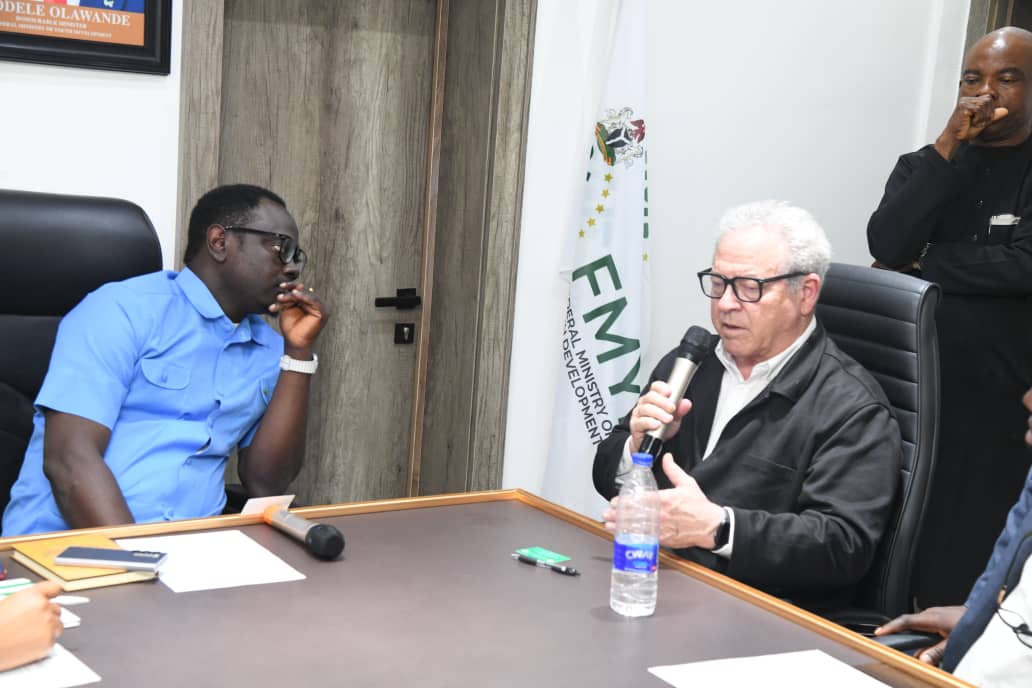
The Honourable Minister of Youth Development, Comrade Ayodele Olawande, disclosed this during a meeting with a delegation from the IHK Giessen-Friedberg Chambers of Commerce and Industry of Germany, led by its President, Dr. Matthias Leder, in Abuja.

Highlighting the Ministry’s vision, Comrade Olawande reiterated the government’s commitment to creating an enabling environment for young people to thrive.

He unveiled an ambitious plan to equip seven million Nigerian youth with essential vocational skills over the next two years.

“Many young people prioritize obtaining certificates, yet without practical experience, success in the job market remains uncertain. To bridge this gap, the Ministry is organizing an intensive three-day skills training program across 50 revitalized Youth Centres, culminating in a central event. This initiative will significantly boost employability and prepare youth for a competitive global workforce,” Olawande stated.

Dr. Matthias Leder described Germany’s Dual Vocational Training system as a potential game-changer for Nigeria, emphasizing that structured on-the-job training has proven successful in meeting public and private sector needs in Germany.

He suggested that granting Nigerian chambers of commerce greater authority by making company membership mandatory would significantly enhance their ability to support economic development.

“Dual Vocational Training presents a win-win opportunity for both countries. While Nigeria grapples with high youth unemployment, German companies are experiencing a shortage of skilled workers. This program proposes sending young Nigerians to receive free vocational training in Germany. If they pass the required exams, they will receive multiple job offers from the companies where they trained, gaining internationally recognized qualifications and promising career prospects,” Dr. Leder explained.

L-R The Honourable Minister, Federal Ministry of Youth Development, Comrade Ayodele Olawande and the former Minister of Information and Culture, Alhaji Lai Mohammed during a meeting with a delegation from the IHK Giessen-Friedberg Chambers of Commerce and Industry of Germany.

Former Minister of Information and Culture, Alhaji Lai Mohammed, who is also the Managing Partner of the initiative, reaffirmed the commitment to strengthening economic cooperation between Germany and Nigeria.

He highlighted that the partnership builds on a longstanding relationship dating back to 2005, with the first visit to Nigeria in 2011. In 2012, IHK Giessen-Friedberg initiated the Dual Vocational Education Project, aimed at transferring key aspects of Germany’s world-class vocational training system to Nigeria.

The collaboration between both nations is expected to play a pivotal role in reducing youth unemployment, fostering skill acquisition, and expanding economic opportunities for Nigerian youth.

IGP Kayode Egbetokun’s Strategic Leadership in Crime Fighting

Maryam Aminu

The Nigeria Police Force (NPF) under the leadership of Inspector General of Police (IGP) Dr. Kayode Egbetokun has intensified efforts to combat crime, making significant strides against armed robbery, kidnapping, cultism, and cybercrime. His leadership, characterized by strategic policing and proactive crime prevention, has reinforced public confidence in law enforcement.

Since assuming office, Egbetokun has demonstrated an unwavering commitment to strengthening the NPF’s operational efficiency. His tenure has seen major successes in tackling violent crimes, with the arrest of 30,313 suspects in 2024 alone for offenses including kidnapping, murder, rape, armed robbery, and illegal firearms possession.

The Force has also recovered 1,984 assorted firearms, 23,250 rounds of ammunition, and 1,438 stolen vehicles, while successfully rescuing 1,581 kidnapped victims.

One of the notable achievements of the NPF under Egbetokun was the daring rescue of one Nigerian and three Indian nationals in Ogun State on June 30, 2024. The operation, despite an ambush by kidnappers, resulted in the safe rescue of the victims and the neutralization of two kidnappers in a follow-up raid. This, among other successes, underscores the IGP’s resolve to dismantle criminal syndicates across the country.

Despite these achievements, Egbetokun acknowledges the complexities of policing in Nigeria, describing it as “an endeavor fraught with challenges, from insurgent activities and armed banditry to organized criminal syndicates and communal clashes.

” The dangers faced by officers were tragically highlighted on February 26, 2024, when six police personnel were abducted and killed during a special operation in the “Evil Forest” of Ughelli North, Delta State. Such incidents underscore the sacrifices made by law enforcement officers daily to ensure public safety.

Beyond tackling violent crime, Egbetokun has led an aggressive crackdown on cybercrime, which has surged with advancements in technology. In a high-profile operation in November 2024, police detectives dismantled a major fraud ring, recovering N3.9 billion and arresting 130 suspects including 113 foreign nationals linked to an international cybercrime syndicate.

This operation highlighted the NPF’s ability to adapt to evolving criminal tactics.

Recognizing that effective crime-fighting requires a motivated police force, Egbetokun has prioritized the welfare of officers. A key initiative in this regard is the establishment of the Nigeria Police Insurance Company, which has facilitated over N12 billion in insurance payouts to 4,223 beneficiaries under the NPF Group Life Insurance Scheme.

Additionally, widows of fallen officers continue to receive compensation, ensuring financial stability for their families.

Egbetokun’s leadership is also marked by merit-based appointments within the Force, placing officers in key positions based on competence rather than ethnic or regional considerations. His tactical deployments have strengthened crime-fighting strategies nationwide, particularly with the appointment of experienced commanders to elite squads.

As IGP Egbetokun continues to push for excellence in law enforcement, his policies of strategic positioning, proactive crime prevention, and officer welfare improvements have laid a strong foundation for long-term security gains. With sustained commitment and minimal political interference, his administration has the potential to significantly alter Nigeria’s security landscape and improve the nation’s global security rating.

His leadership is not just about fighting crime but also about redefining the effectiveness of the Nigeria Police Force in ensuring law and order across the country.